
5 SOP Examples: Real Standard Operating Procedures to Copy
These SOP examples are filled-in standard operating procedures, real standard operating procedures examples to study before writing your own, built for ops, HR, IT, and customer-service leads needing a specimen, not a blank template. Five industry-diverse specimens below, each a rendered preview plus downloadable PDF.
Jump straight to the examples.
What an SOP is: step-by-step instructions for a routine task, written for consistency. Five sop samples below: Coffee Shop Opening, Password Reset, Warehouse Safety Check, New-Hire IT Setup, Customer Refund Processing.
A good one: purpose and scope up top, numbered steps a newcomer runs alone, checkable values, a document control block.
When you need one: training new staff, proving compliance, holding quality steady through turnover.
Strong vs weak sample sops: Strong SOP examples use measurable values and clear actions. Weak examples rely on vague verbs and general instructions.
What Makes a Good SOP Example
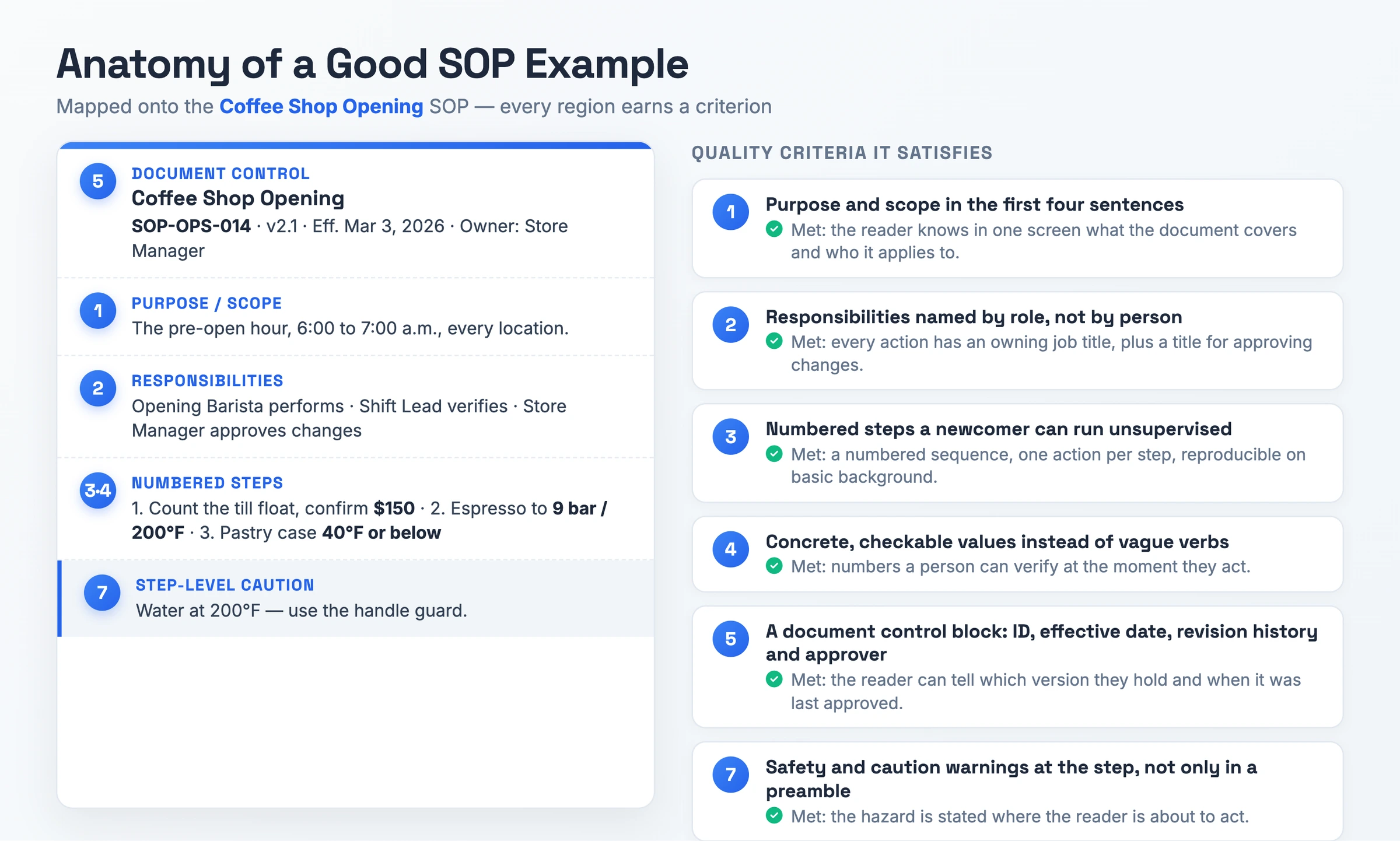
- Purpose and scope in the first four sentences. A strong example tells you in one screen what it covers and who it applies to. A weak one opens straight into step 1, so you cannot tell whether it is meant for you.
- Responsibilities named by role, not by person. Every action has an owning job title, and a separate title approves changes. Name an individual employee and the document breaks the day that person leaves.
- Numbered steps a newcomer can run unsupervised. One action per step, detailed enough that someone with basic background reproduces the result alone. A narrative paragraph forces you to go ask a colleague.
- Concrete, checkable values instead of vague verbs. The steps carry numbers you can verify at the moment you act, a 200°F target, a $150 float. Verbs with no measurements are the weak-specimen failure mode: without a value to check against, no one can confirm the step was done right.
- A document control block: ID, effective date, revision history, and approver. You can tell at a glance which version you hold and when it was last approved. An undated document nobody owns is the opposite.
- Safety and caution warnings at the step, not only in a preamble. The hazard sits where you are about to act, in bold. You forget a safety paragraph at the top by step 6.
5 SOP Examples Worth Copying
Each specimen below is a filled-in preview. The summary blocks copy straight into Word, Google Docs, or Excel, and the full SOP is available as a PDF download. The five answer a common question, what are some examples of standard operating procedures, with complete standard operating procedure examples drawn from five different industries, so you can pick the one closest to your own work.
Example 1: Coffee Shop Opening
For a small-team retail or food-service operator whose opening shift is run by whoever is rostered.
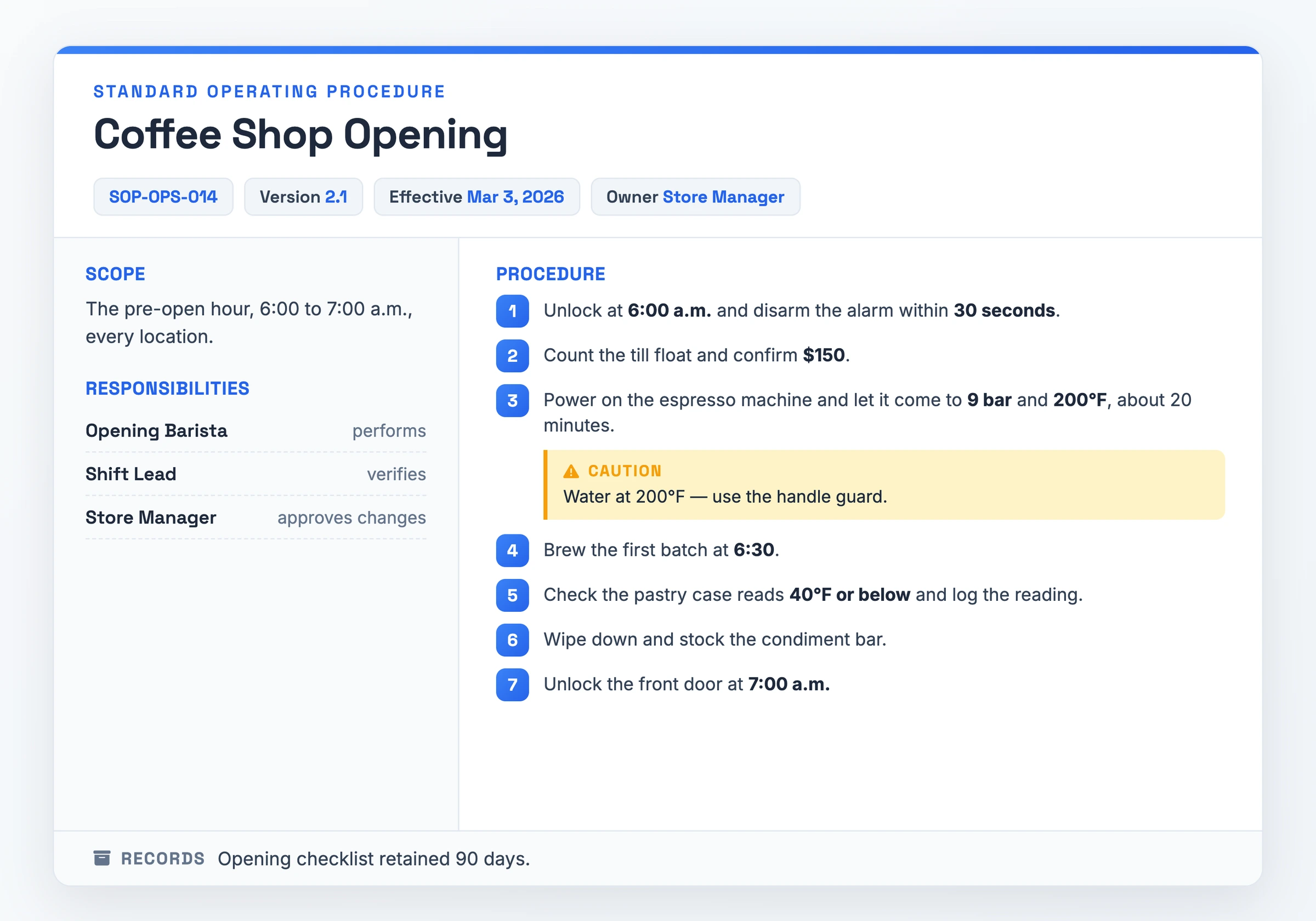
What makes it work: each step carries a number you can check on the spot, count the till float and confirm $150, bring the espresso machine to 9 bar and 200°F, hold the pastry case at 40°F or below. The caution sits at the espresso step itself, water at 200°F, use the handle guard, not buried in a preamble. A records line at the foot sets a 90-day retention period.
Watch out for: the $150 float and the 90-day retention are site-specific. Reset both to your own store's numbers before you reuse it.
Example 2: Password Reset
For an IT service desk handling a high-volume, identity-sensitive request.
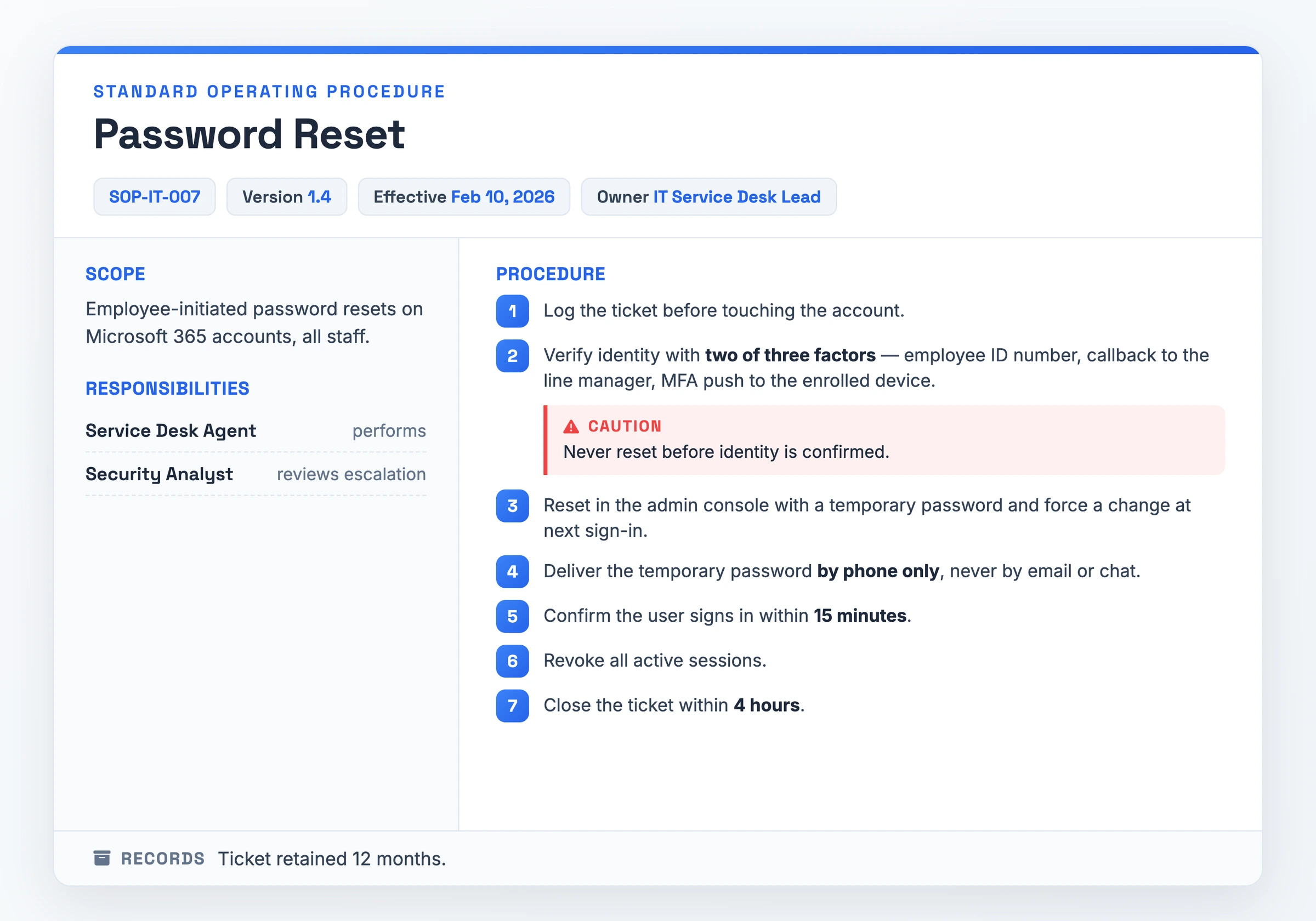
What makes it work: responsibilities split cleanly, the Service Desk Agent performs and a Security Analyst reviews any escalation, and the agent verifies identity with two of three factors before resetting anything. The timings are checkable too, sign-in confirmed within 15 minutes, ticket closed within 4 hours.
Watch out for: the phone-only delivery and the MFA factors assume Microsoft 365 and an enrolled-device fleet. Swap in your own identity provider before reusing it.
Example 3: Warehouse Safety Check
For a warehouse or plant where a pre-shift inspection is a safety and compliance requirement.
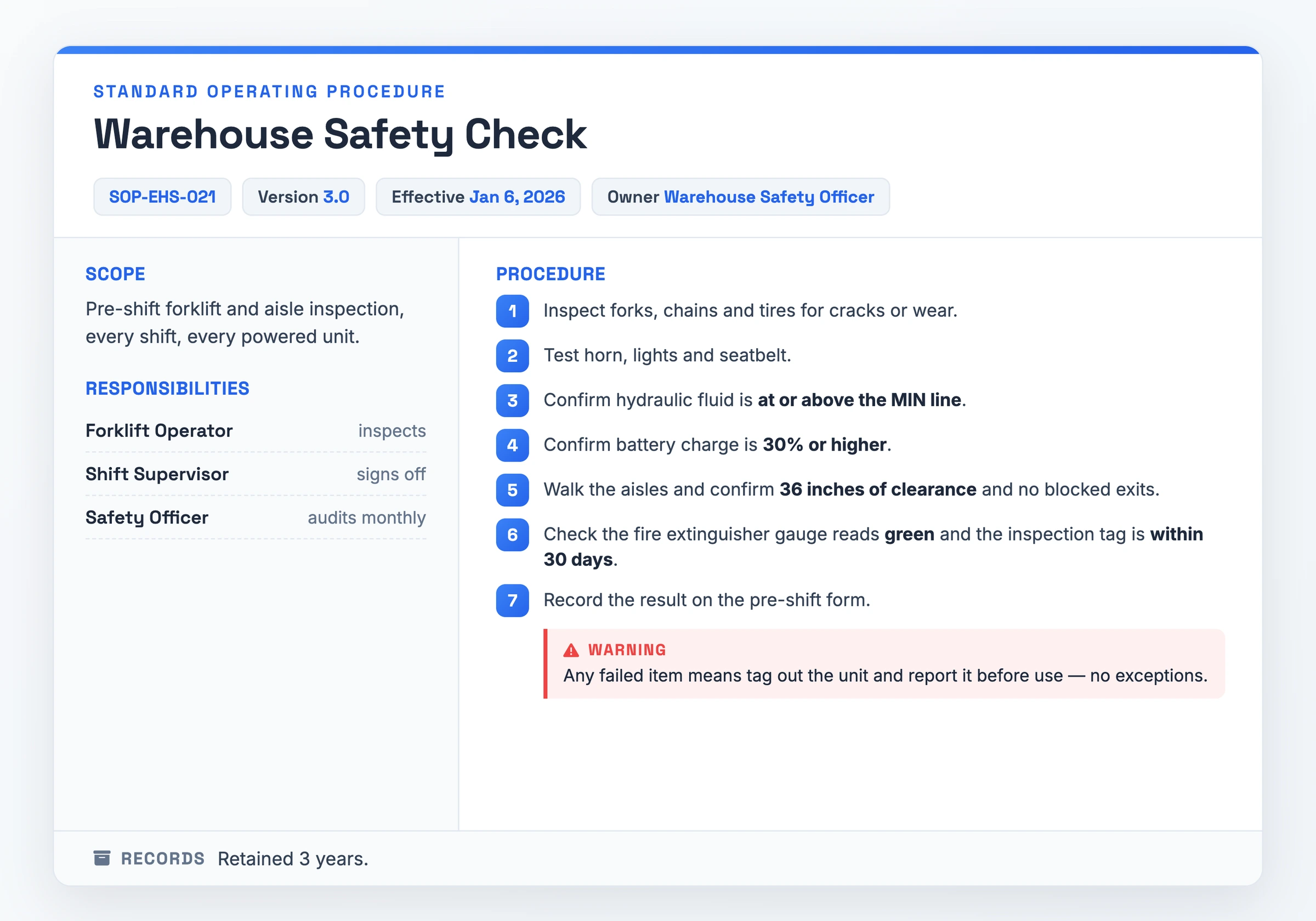
What makes it work: the warning lands at the final step, any failed item means tag out the unit and report it before use, no exceptions, exactly where the reader is about to act. Each check is a threshold you read off a gauge, hydraulic fluid at or above the MIN line, battery charge 30% or higher, 36 inches of aisle clearance, an inspection tag within 30 days. A records line sets a 3-year retention period.
Watch out for: the 36-inch clearance and the 3-year retention are jurisdiction-specific. Confirm your local code before you copy those numbers.
Example 4: New-Hire IT Setup
For an ops or IT manager handling day-one provisioning across HR and IT.
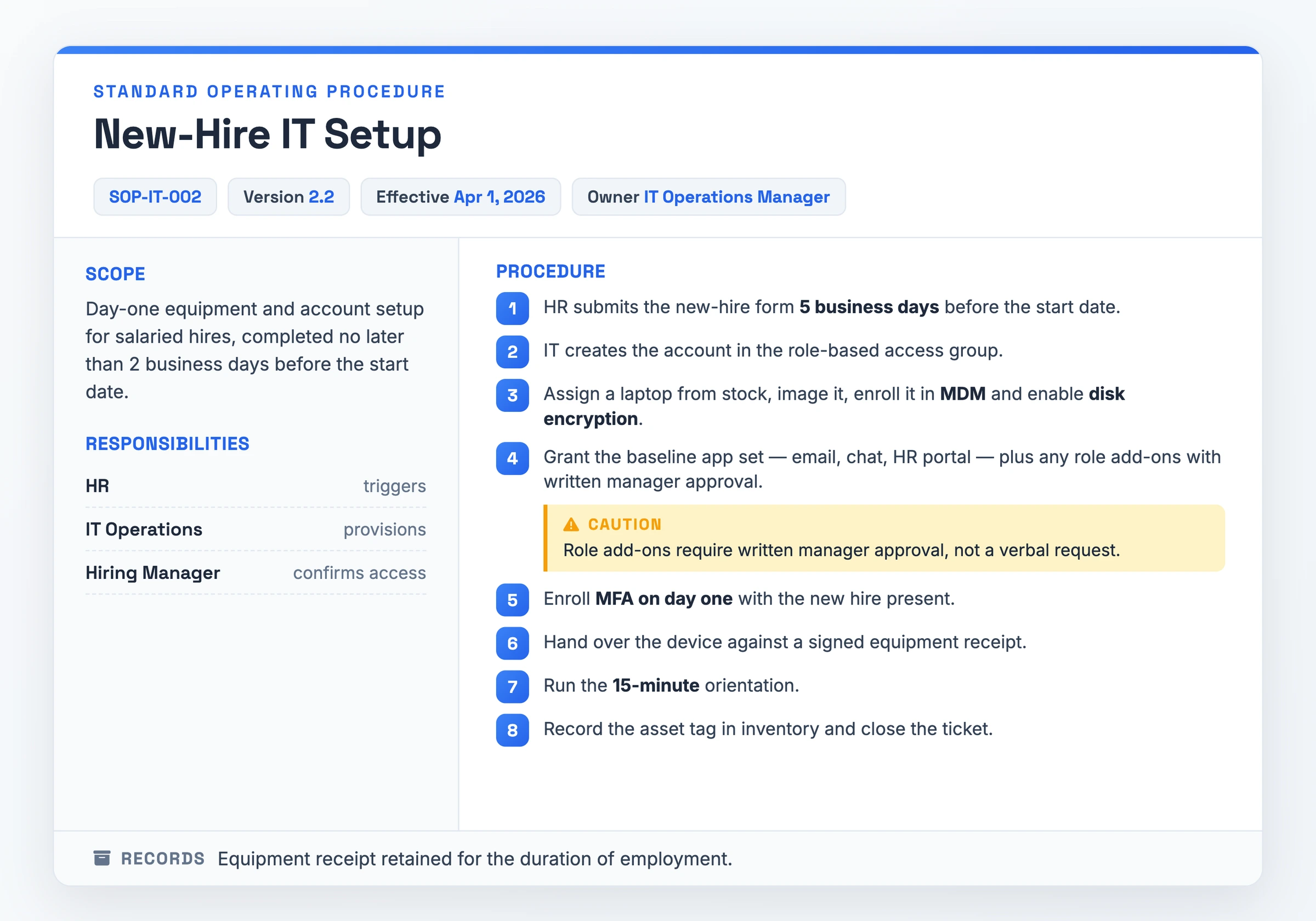
What makes it work: the scope is explicit, day-one setup finished no later than 2 business days before the start date, and the steps run as one numbered sequence across three teams, HR triggers, IT Operations provisions, the Hiring Manager confirms access. The document control block dates it precisely, SOP-IT-002, version 2.2, effective April 1, 2026.
Watch out for: the "2 business days before start" deadline and the role-based access groups assume an existing MDM and inventory stack. Adjust the timing and the tooling to what your team runs.
Example 5: Customer Refund Processing
For a retail or e-commerce customer-service team processing returns and refunds at the counter or over the phone.
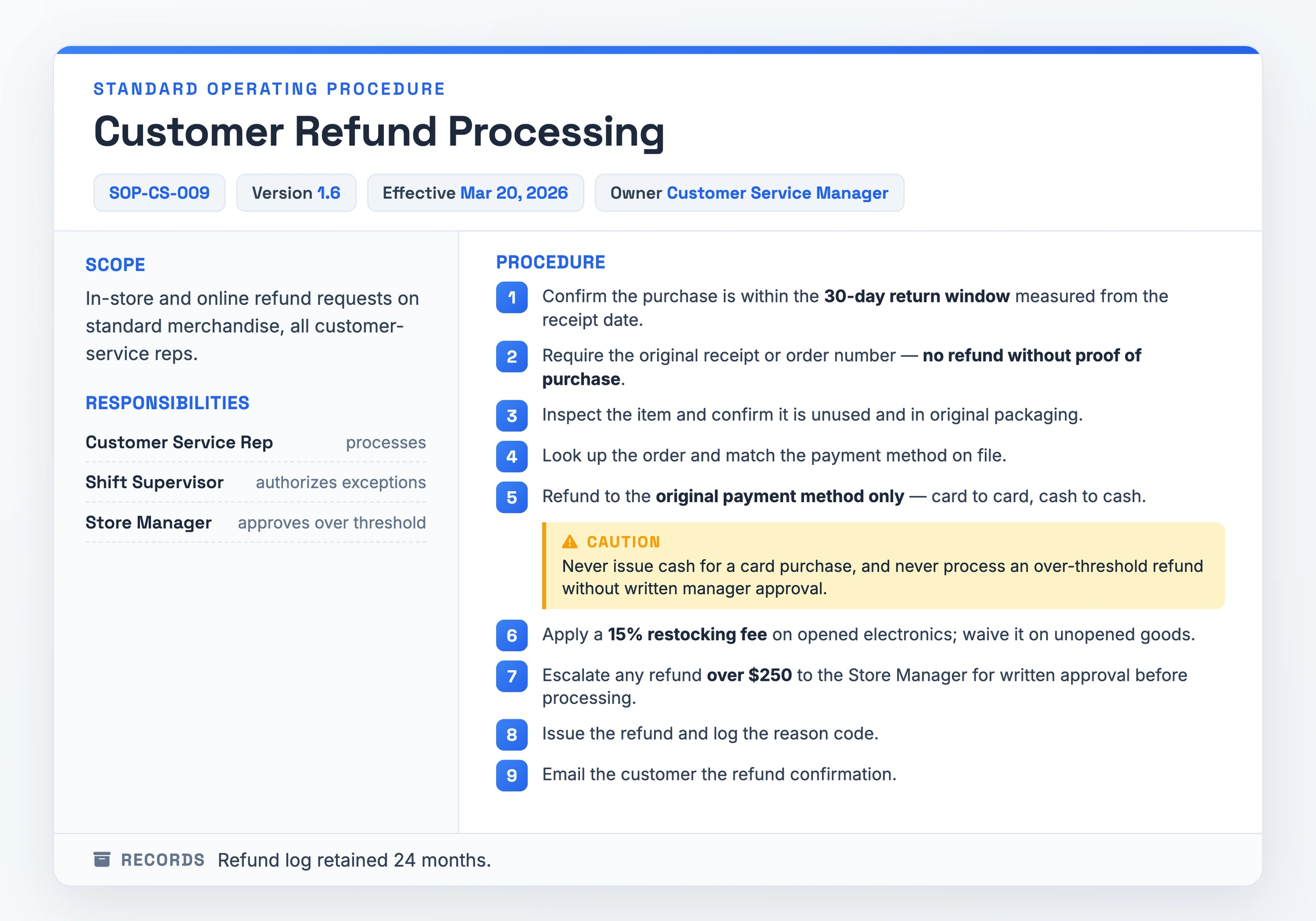
What makes it work: the policy numbers are concrete and checkable, a 30-day return window, refunds to the original tender only, a $250 manager-approval threshold, a 15% restocking fee on opened electronics. Escalation is role-based, the Rep processes, the Shift Supervisor authorizes exceptions, the Store Manager approves anything over the threshold.
Watch out for: the $250 threshold and the 15% restocking fee are policy numbers. Match them to your own return policy before you publish it.
How to Adapt an SOP Example
- Start from the specimen closest to your work. Pick the gallery example that matches your industry and task, the Coffee Shop Opening SOP for a retail open, and build on its structure instead of a blank page.
- Rewrite the document control block. Swap the ID, owner, and effective date for your own, and leave the effective date as "Pending Approval" until someone signs off.
- Replace each step with your actual process. Keep one action per step, active voice, main idea first, at a detail level where someone new can run it unsupervised.
- Assign responsibilities by role. Name the job title that performs each step and a separate title that approves changes, titles only, no employee names.
- Define any term the reader might not share. List acronyms and site-specific jargon once, alphabetical, and use them consistently through the steps.
- Have someone who did not write it test the draft. Watch a person with the stated background run the procedure, then fix any step that reads wrong in practice.
- Version it and put it where the work happens. Record the issue date and revision number, then distribute so the current copy is the only one in circulation.
When You Need an SOP
Reach for an SOP the first time a task moves from the person who usually does it to someone new. A small team feels this fastest: one experienced person takes leave, and the New-Hire IT Setup kind of work stalls because the steps lived in someone's head. A written procedure lets a new hire run it unsupervised.
Write one when the work gets audited, or could be. An auditor reads an SOP as a checklist. A dated, role-owned document is the difference between saying you follow a process and showing it, the way the Warehouse Safety Check exists for that inspection.
You also need one to hold quality steady as staff turn over. With each rep handling a refund the same way, the Customer Refund Processing SOP keeps the outcome consistent whether it is a first-week hire or a ten-year veteran.
Common SOP Mistakes
- Letting the document go stale after the process changes. The procedure moves on and the SOP does not, which means staff follow last year's steps. Update and re-approve it the moment it changes, and record the date.
- Writing it in language the reader can't act on. Vague verbs, and "may" where you mean "must", leave the reader guessing. An ambiguous instruction defeats the point: removing doubt about what is required.
- Writing it so long it goes unread at the workstation. A five-page SOP goes unread while the task happens. Keep it short enough to scan on the job, or it sits unused in a drawer.
- Copying a generic template without tailoring it to your site. One that names another team's tools and conditions does not match your work. People stop trusting it by the third wrong detail.
- Publishing without a second person testing the draft. The writer knows the gaps too well to see them. Have someone else run the draft first, or the missing step surfaces during a live task.
Skip the Blank Page: Record It Instead
Each specimen in the gallery started as someone's process before it became a document. If you have already walked a new hire through that process on a call or a screen recording, you do not have to retype it into a blank page.
Hinto AI turns a screen recording into structured, filled-in documentation like the SOPs above. Capture your screen, camera, and microphone in the web app or the Chrome extension, and Hinto analyzes the recording, extracting screenshots and written steps automatically. It supports common sources such as Loom, Zoom, YouTube, and local MP4, MOV, or WebM uploads, subject to file-size and access requirements, which fits the training and onboarding recordings ops and HR managers already make.
The finished SOP goes live on a public URL with a custom domain, ready to share the same way you would share any specimen in this gallery.
SOP FAQ
What are some examples of standard operating procedures?
The five specimens here are examples: Coffee Shop Opening, Password Reset, Warehouse Safety Check, New-Hire IT Setup, and Customer Refund Processing. Each has a purpose and scope, role responsibilities, and numbered steps with concrete, checkable values, from varied industries.
What is SOP with an example?
An SOP is step-by-step instructions documenting a routine task so the result stays consistent. The Password Reset specimen shows it: a defined scope, a named owner, and seven numbered steps that verify identity before resetting anything, detailed enough to run unaided.
Can I write my own SOP?
Yes. Start from the closest specimen, swap in your own ID, owner, and effective date, then rewrite the steps to your process in detail a newcomer can follow. Assign responsibilities by role, and have someone who didn't write it test the draft first.
How do I write an SOP for a job?
Write it from the person doing the job outward: number the steps in order, one action each, and add concrete values and role owners a new hire would otherwise ask about. Or record the task once and turn that into the SOP.
Can I get an SOP example in PDF or Word?
Yes. Every specimen here has a downloadable PDF, and the on-page summary blocks copy straight into Word or Google Docs. Take the full SOP as a PDF for a handout, or copy the summary text to adapt.

Product leader focused on building consumer products with empathy. Former Head of Product at Chime and Craft, specializing in AI-assisted workflows and platform innovation.
Ready to Build a Better
Knowledge Base, Faster?
Get Started Free & Create Your First Article in Minutes