
How to Get Your New Product Featured in ChatGPT & AI Answers
The "Launch" that no one could see
Congratulations on finishing your app! You may have even done it all in one weekend (and got your website up with everything working) and shared it with your friends via social media!
But then you got curious and asked ChatGPT, "What are the best tools for [what your app does]?"
And after reading the response, you found such tools as Notion, Zapier and several others listed but never saw your own app mentioned in the response at all! How is that possible?
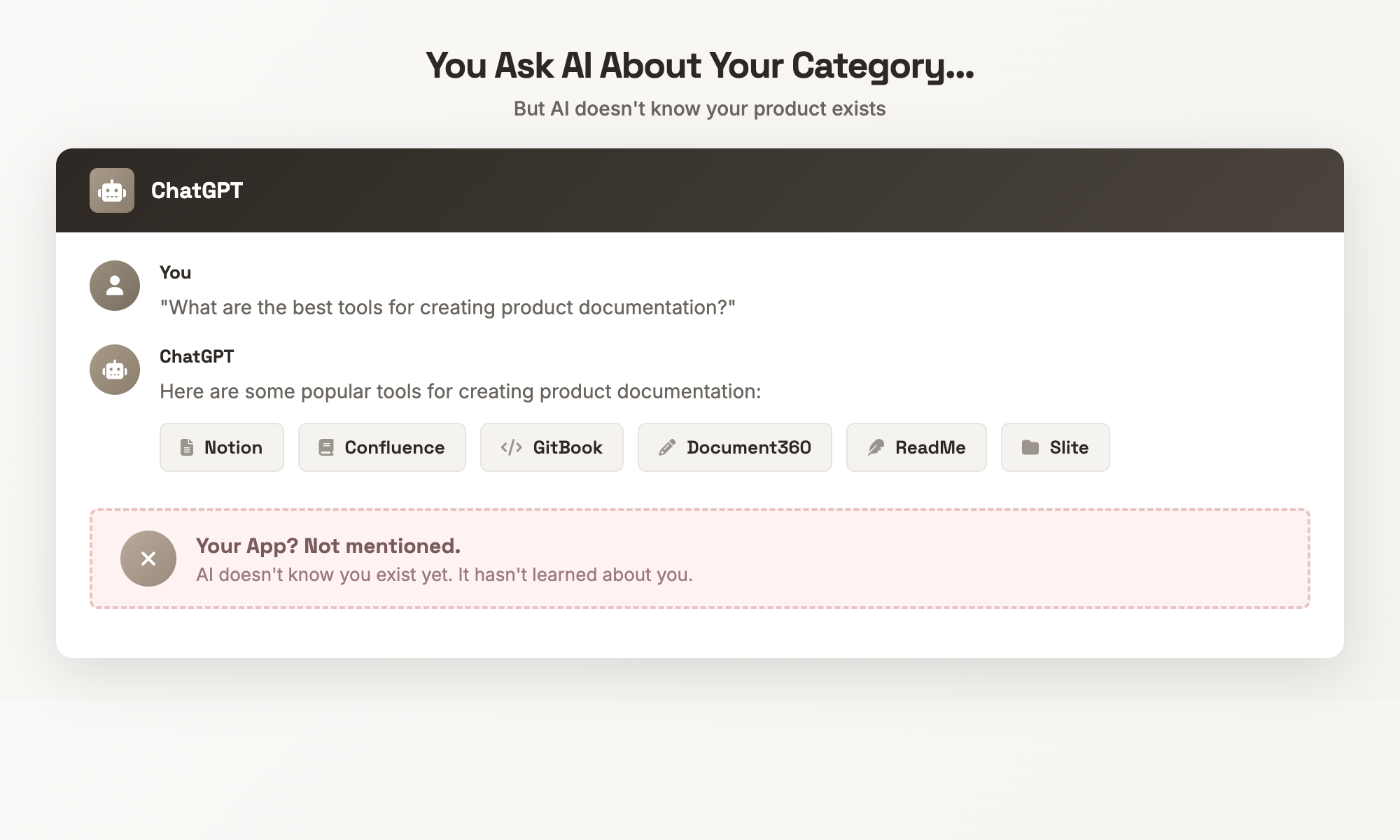
When asking AI about your product category, it is non-existent in AI's world.
You have used other AI tools for the same query and have received similar results. In the world of AI there is no record of you at all.
How Individuals Are Discovering New Things
The way people are searching has changed.
People no longer only search on Google; in fact, they are increasingly asking AI questions. From asking "How do I receive invoices on autopilot?" or "What is the best app to screen record?" to wanting a direct answer to their question rather than seeing a list of web addresses.
The new search methods have also changed how people find products.
As people continue to use AI, it will become the primary method in which people discover new content. However, AI can suggest items only if it "knows" them.
This begs the question: What does an AI need to know about your product before it can provide a recommendation?
The process of how artificial intelligence learns about a product can be likened to passing a message along a line of people. If you are not in the first message passed along that line, you’ll never receive the final message.
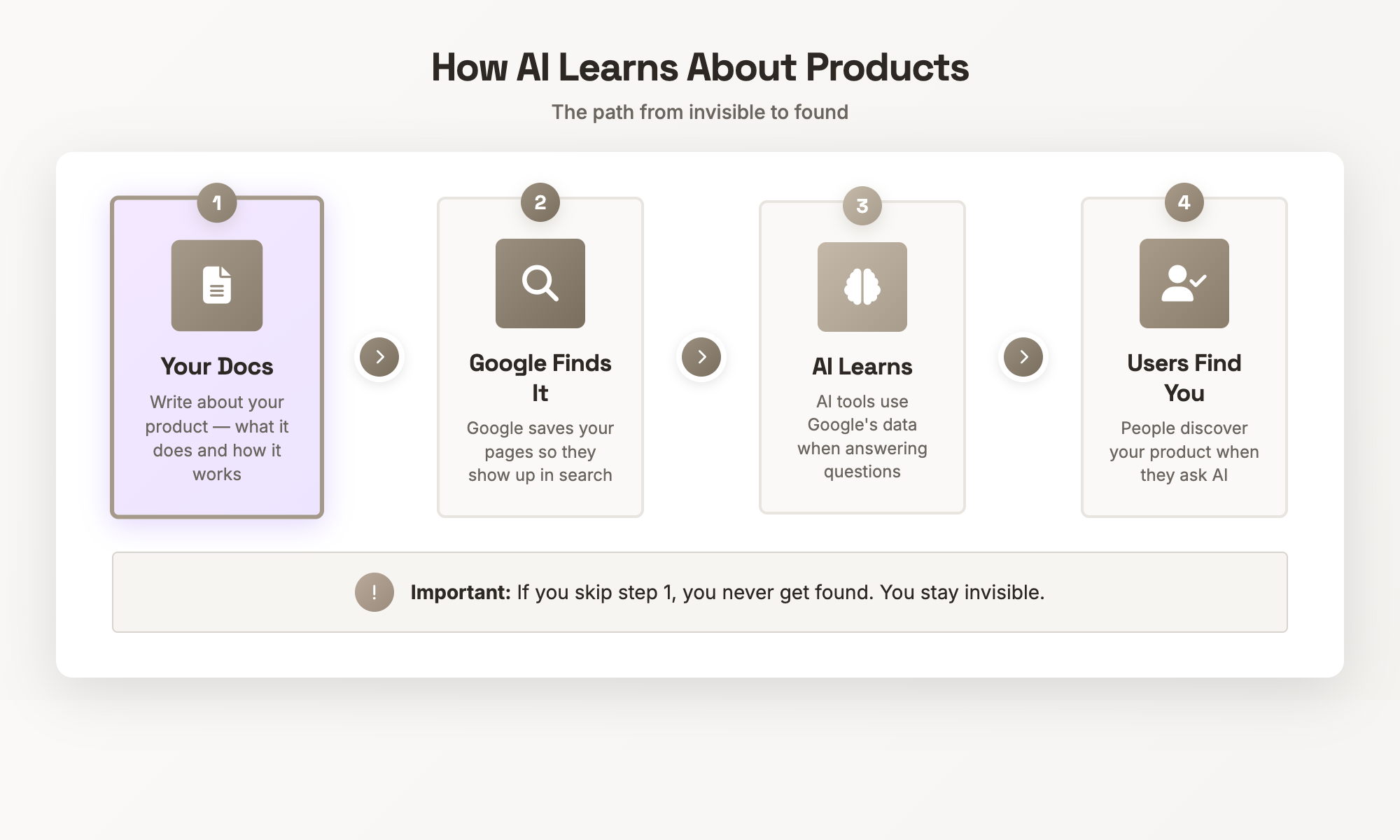
The path from invisible to found: Docs → Google → AI → Users
Here's how it works:
- You write about your product: what it does, how it works, who it helps
- Google finds that content and adds it to its search index
- AI tools use Google's data when answering questions
- Your product shows up in AI answers when someone asks something your product can help with
That's why it isn't enough to simply post on Twitter. Twitter posts only stay public for a very short period of time, and thus are difficult to locate by either AI or search engines after their initial "tweet".
If you do not complete your first step, you will remain invisible, and cannot continue through this process.
The Old Way vs. The New Way
Most people who build products think like this:
"Help docs? I'll write those later. First I need users. Right now I'm focused on building and marketing."
It was logical at one point. The Help Center/articles were only meant for users of your app — to help them find answers.
Now, it has changed.
Help articles are not only for users of your product. They are also helping AI discover you. You write articles for the purpose of teaching AI about your company before you ever have any users — telling AI what your product does and what problems it solves.
Therefore, your articles should be the first way to be discovered rather than the last thing you write.
Everything That Should Be Included In Your Documentation
There is no need for you to create an extensive collection of manuals however, you will want to take the time to answer general questions that other users might have about artificial intelligence in relation to how they would query it.
Consider writing out your documentation similar to that of a job application, as the user through querying for "an application to do X", will reference brokering an application - therefore stipulating why you are qualified as a candidate.
There are six key points you should have in your documentary:
- Who it's for: What kind of person or business would use this?
- The problem: What issue does it solve? Say it simply.
- How it works: Walk through the main steps.
- What it does: List the main things it can do.
- What it doesn't do: Be honest about limits. This builds trust.
- How to start: How does someone sign up and begin?
Think about what people ask AI:
- "What tools help with [your problem]?"
- "How do I [what your product does]?"
- "What's the best way to [the result you provide]?"
The better and clearer your documents are at answering those questions, the higher the chance of AI recommending you. Vague language, such as referring to "a powerful tool for teams", provide no basis for AI to make a recommendation for you. Therefore, specific wording, such as "turns screen recordings into a series of instructions", gives the AI something much more tangible to use as a reference point.
Document creation and publishing
Here's where it gets real...
You need to write documentation for your product and make it available online, but don't feel pressured to be perfect; you just need to be available.
To do this as fast as you can, you might record a short video of you using your product (5-15 minutes), walk through the steps as you go along, and then produce your written documentation from the video you recorded.
This happens almost automatically with tools like Hinto:
- Upload your video. Hinto watches your screen recording and listens to your voice.
- Review the outline. It creates a list of articles based on what you showed.
- Generate the articles. Click a button and it writes each one, with screenshots from your video.
- Publish. Your docs go live on a web address you can share.
When you make a publication, Hinto makes a new sitemap and also makes a special file ("Tensorfile") that is called llms.txt, which helps AI read what is written on your site easier. You can also connect your site to Google, which allows Google to index your pages quicker.
So, this was the first step. What you have accomplished is informing the world what your product is about in a way that will be understood by both people and AI.
Step 2: Obtain Links from Other Websites
Google uses its own algorithm when it finds new content, but the most important way Google uses this algorithm differs from the way AI uses it; Google judges the trustworthiness of your website specifically by a number of links it receives pointing towards that site.
Google essentially uses links as a way to judge whether or not your website is trustworthy; therefore, a site linking to yours is like a vote saying you are worthy of being looked at.
Most people think they can just sit around and wait for other people to start linking to them naturally, which is too slow; you can generate your first links almost immediately.
To create some initial backlinks quickly:
- Create accounts on major sites like X, LinkedIn, GitHub, Product Hunt
- Put your website link in each profile
- On your own website, link back to those profiles
- Add your product to lists and directories in your space
This builds a web of real connections. Google understands that your product is actual and not just a random website; it's connected to real accounts on real platforms, so consequently, making it look real.
There are much more advanced methods of gaining backlinks; however, for the time being, this is the simplest way that you can begin!
The Effects of Publishing
You can expect an expedited response as a result of publishing, although the response will not be instantaneous.
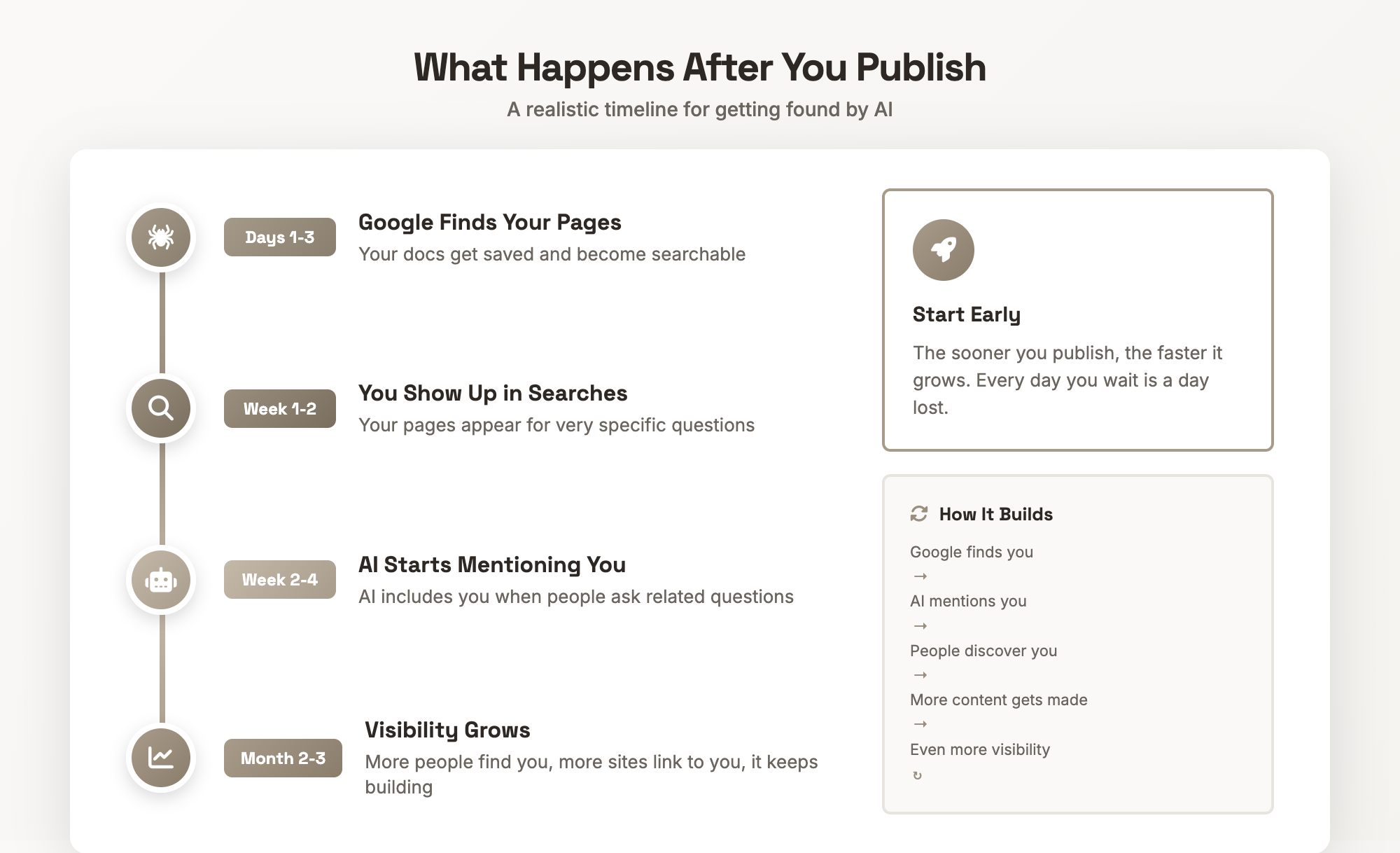
What to expect after you publish your docs
Here's a rough timeline:
- Days 1-3: Google finds and saves your pages
- Week 1-2: Your pages start showing up for very specific searches
- Week 2-4: AI starts mentioning you when people ask related questions
- Month 2-3: More people find you, more sites link to you, and visibility grows
Whenever a user queries ChatGPT with a request that can be fulfilled by your solution or a request for information related to your solution, they will not only see your product, but also reference documentation about your solution when it appears in Google's search results.
Here's how it works:
- Google finds you
- AI mentions you for small questions
- People discover you through AI
- More people use you, more content gets created
- AI mentions you for bigger questions
First and foremost, to succeed, you must believe that success will occur. You will succeed by proving your product and believing in your product! You don’t have to have the most significant amount of followers at first; you will be to be seen & heard. Don’t forget about the people that you can give an answer to! The soonest you can find your success, the quicker you will achieve the growth you want!
The 60-Minute Version
If you're in a hurry, here are the fastest steps to take:
| Task | Time |
|---|---|
| Record a video walkthrough for your product or service | 15 min |
| Upload your video to Hinto's website, and complete the structure outline | 5 min |
| Create content for each article by using GHL’s articles and writing tools | 10 min |
| Publish your articles and connect them to Google’s services to ensure indexing | 5 min |
| Create a social media profile for yourself, including links to the above-mentioned material | 20 min |
After completing all of these steps in under an hour, AI will be able to find and recommend you based on your product details. Your documentation is live on Hinto, indexed by Google, and ready for action!
Frequently Asked Questions About Showing Up in ChatGPT and AI Answers
How do I show my product in ChatGPT?
You cannot send your product to ChatGPT directly.There is no form to fill out.
AI tools learn by reading public pages on the internet.If your product is explained online, AI can find it.
To show up, your product needs clear pages that explain:
- What it does
- Who it is for
- What problem it solves
Those pages must be public and easy to read.If AI can read about your product, it can mention it.
Why doesn’t ChatGPT know my product exists?
Most of the time, it is very simple.
There is not enough clear information online.
Common reasons include:
- No help pages or guides
- A website with very little text
- Pages not showing up on Google
- No links from other websites
- Very vague wording like “a powerful solution”
AI does not guess.It only repeats what it can clearly read.
How does AI learn about new products?
It usually follows this order:
Documentation → Search engines → AI → Users
First, you publish content about your product.Then Google finds and indexes it.Then AI systems read that information.After that, users see your product in answers.
If you skip the first step, nothing else happens.
Can I submit my startup directly to ChatGPT?
No, you cannot.
There is no way to apply or submit.
AI learns from:
- Public websites
- Articles and reviews
- Help centers
- Product listings
The goal is not to submit.The goal is to explain your product clearly online.
What kind of content helps AI recommend my product?
Content that answers real questions works best.
For example:
- What tools help with invoices?
- How do I turn videos into guides?
- What apps help with onboarding?
Your pages should explain:
- Who the product is for
- What problem it solves
- What it can do
- How it works
- What it cannot do
- How to start using it
Clear words are better than marketing language.
Do social media posts help AI discover my product?
Not very much by themselves.
Social posts:
- Disappear quickly
- Are hard to index
- Do not explain much
They can help people find you.But they do not replace proper documentation.
How long does it take to appear in AI answers?
It does not happen overnight.
A rough timeline looks like this:
In the first few days, pages get indexed.After one or two weeks, you may appear in small searches.After a few weeks, AI may start mentioning you.After a few months, visibility builds up.
Good documentation makes this faster.
What is the fastest way to become visible to AI?
A simple approach works well.
First, record a walkthrough of your product.Then turn that into help articles.Publish those articles on your site.Make sure Google can index them.Add links from profiles or directories.
Once AI can read clear information about you,visibility can start.
Summary
You have created a product. You need to promote this on the Internet so that Artificial Intelligence understands all of the information that you have created.
Previously companies would build a product first and then recruit users to use it and finally write documentation about the product.
Companies today will build their product, create documentation about it, then AI will index that documentation, and only once that has been completed will they look for users for their product.
Documentation should be launched as part of the overall launch of a new product (rather than afterwards), meaning that documentation is the first thing to be published after a product launch.
If AI does not know about your product, then it is unlikely that any users will know about your product.

Product updates, feature announcements, and best practices from the Hinto product team.
Ready to Build a Better
Knowledge Base, Faster?
Get Started Free & Create Your First Article in Minutes