
Ultimate Employee Onboarding Process Blueprint
Employee onboarding process. The first three months of a new hire's journey are critical for their long term success with your organization, yet too many companies treat onboarding as a one-day, quick tour of the office, a pile of paperwork and a 'good luck!' before dropping their new employees into the deep-end. Ouch. The truth is, organizations that invest in structured, multi-part onboarding programs see much better outcomes. Research shows that employees who receive intuitive onboarding are 69% more likely to stay with a company for three years(source).
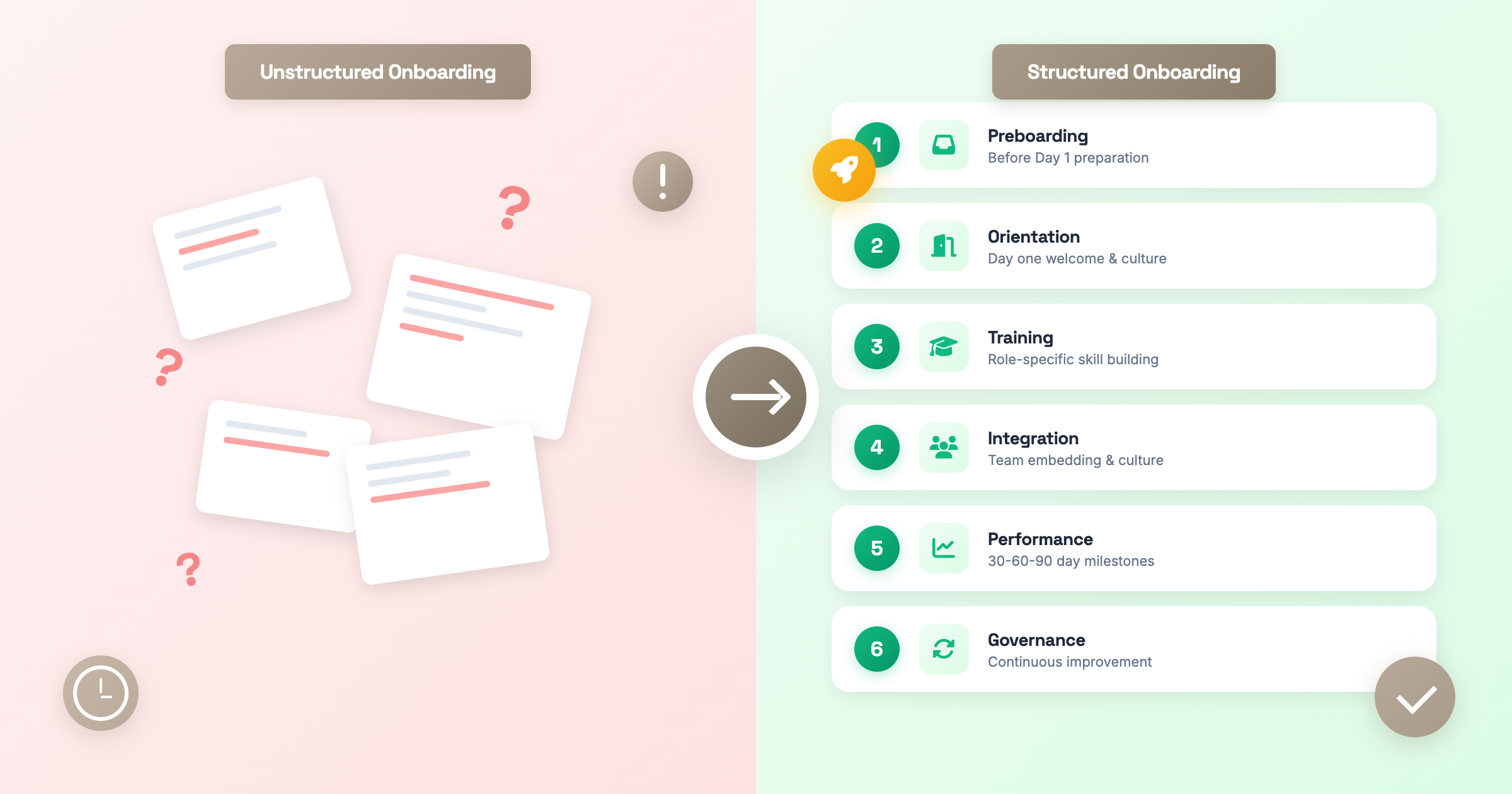
Onboarding Program Overview: Stages, Goals, and Key Players
What is onboarding for a job, really? Far more than a single orientation session or a folder of policies to sign. To onboarding employees effectively, we need a structured journey that unfolds over weeks and months—not hours. We need to build a bridge between the excitement of accepting an offer and the confidence of being a fully contributing team member. A quality hr onboarding process has three complementary goals:
- Engagement: Creating emotional connection to the organization's mission and culture from day one
- Competence: Developing the skills and knowledge needed for role-specific success
- Retention: Building the relationships and clarity that keep talented people invested long-term
Phases of Onboarding at a Glance (Overview)
This onboarding guide lays out the new hire journey in six phases:
- Preboarding - From offer acceptance to the first day
- Orientation - Day one immersion and welcome activities
- Training - Role-specific skill development (weeks 1-4)
- Social Integration - Team embedding and cultural connection (weeks 2-8)
- Performance Alignment - Goal setting and 30-60-90 day checkpoints
- Governance - Continuous improvement and extended support (months 3-12)
Each phase builds on the previous, creating momentum rather than isolated events.
Who Are The Key Players? (HR, Manager, Buddy, IT)
| Who | Responsibilities |
|---|---|
| HR | Documentation, training and resources for compliance tracking, analytics and insights tracking, design and guide the process. |
| Hiring Manager | Describe the role, set goals and expectations, give performance feedback, talk about personal development. |
| Onboarding buddy | Peer for questions, cultural translator, informal resource, office buddy. |
| IT/operations | System access, equipment, tech onboarding, credentials. |
Ready to see how this coordination works in practice? Let's start from the very top—preboarding.
Preboarding Preparation & Early Engagement (Phase 1)
The time period that exists between an external candidate's acceptance of an offer and their first day on the job is often free time that organizations don't take full advantage of. As an impatient (but very, very excited) new hire waits, excitement can be replaced with anxiety, questions arise, and second thoughts begin to wander. That’s exactly why preboarding—structured engagement on behalf of organizations that occurs before day one—is a necessary step in the employee onboarding process. Researchers at the University of Pennsylvania discovered that managers who engage in cultural socialization during this window will, twelve months later, see higher newcomer performance and retention rates than managers who do not(source). Beginning the relationship early leaves a golden print.
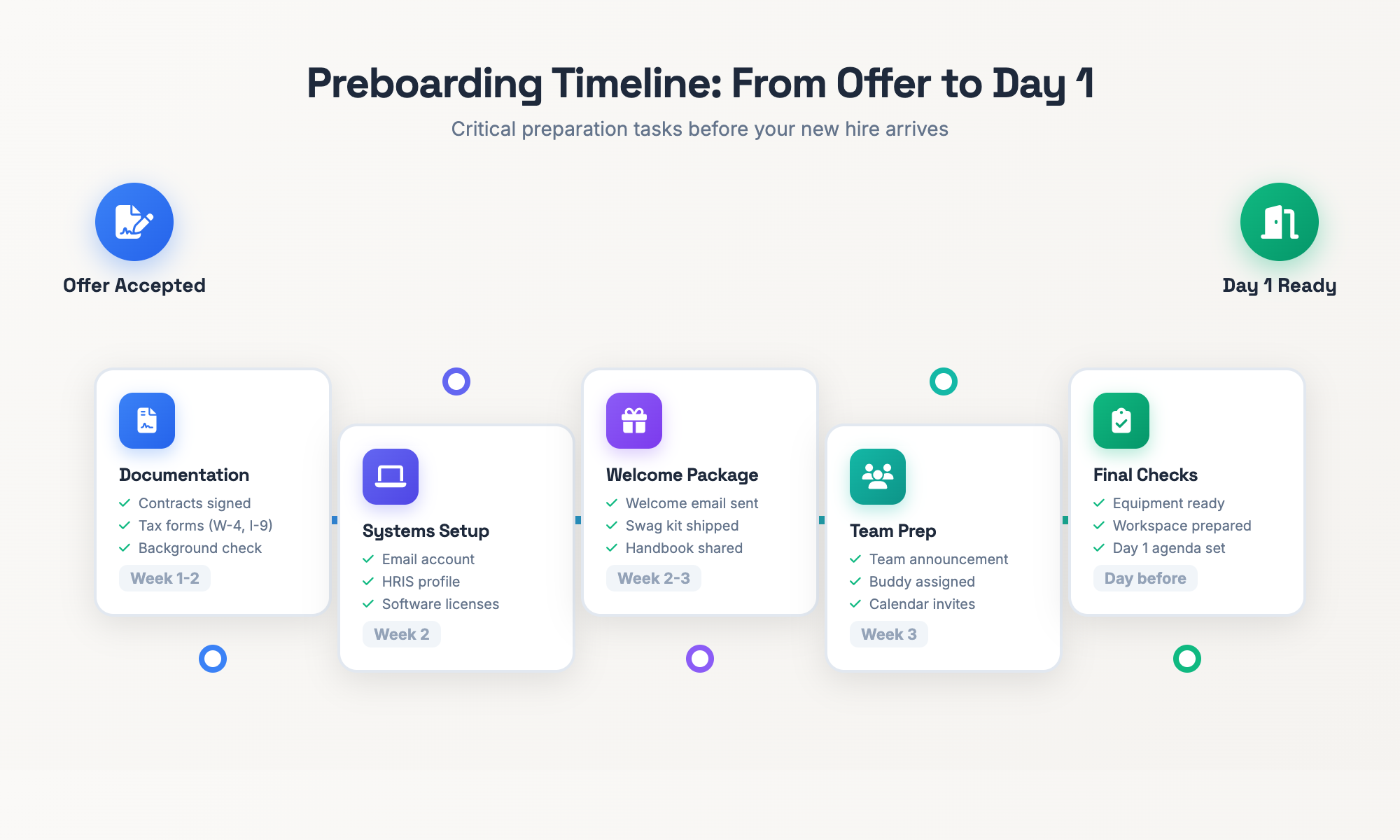
Essential Preboarding Tasks
Administrative groundwork needs to be in place before your new hire steps foot (or logs in remotely on) Day One. Cover these key items in the preboarding process.
- Compliance and Documentation:
- Employment contracts and offer letter acknowledgment
- Tax forms (W-4, I-9 verification)
- Background check completion
- Policy acknowledgments and confidentiality agreements
- Benefits enrollment materials
Systems and Access:
- Email account creation and credentials
- HRIS profile setup
- Security badge or access credentials
- Required software licenses provisioned
- Equipment ordered and configured (laptop, phone, peripherals)
Tip: Create a shared tracking document visible to HR, IT, and the hiring manager. When everyone sees the same checklist, nothing falls through the cracks.
Welcome Package & Communication
Welcome email essentials:
- Start date, time, and location (or virtual meeting link)
- First-day agenda overview
- Dress code guidance
- Parking or transportation details
- Primary point of contact with direct phone number
- Link to employee handbook or culture documents
Team Prep and Announcements
How you remove current team members will determine how welcomed the newcomer feels on day one. Prep them:
- Send an internal announcement introducing the new hire (with their permission, include a photo and brief background)
- Brief the immediate team on the new person's role and how they'll collaborate
- Identify 2-3 colleagues who should schedule introductory conversations in week one
- Confirm the onboarding buddy assignment and brief them on expectations
Quick Preboarding Micro-Checklist
Make sure you check off everything on this list before your first day.
- Offer letter signed and returned
- Background check cleared
- All compliance documents submitted
- Email and system accounts created
- Equipment ordered and delivery confirmed
- Welcome email sent with first-day details
- Welcome kit prepared or shipped
- Team announcement distributed
- Buddy assigned and briefed
- First-week calendar invites sent
- Manager has prepared week-one discussion topics
Assigning Responsibilities - RACI Chart
Clarity prevents confusion. This responsibility matrix defines who owns each preboarding task:
| Task | Responsible | Accountable | Consulted | Informed |
|---|---|---|---|---|
| Offer letter and contracts | HR | Hiring Manager | Legal | New Hire |
| Background verification | HR | HR | Hiring Manager | New Hire |
| System account creation | IT | IT | HR | Hiring Manager |
| Equipment provisioning | IT | IT | Hiring Manager | HR |
| Welcome email | Hiring Manager | HR | - | Team |
| Buddy assignment | Hiring Manager | HR | Team Lead | Buddy, New Hire |
| Team announcement | Hiring Manager | Hiring Manager | HR | Full Team |
| First-week calendar setup | Hiring Manager | Hiring Manager | Buddy | New Hire |
Download: Preboarding Checklist - A customizable spreadsheet template covering all pre-start tasks with ownership columns, due dates, and status tracking. Adapt this to your organization's specific compliance requirements and workflow.
Download: Welcome Email Template - A ready-to-personalize welcome message template ensuring consistent, warm communication with every incoming team member.
How does all this preparation pay off? Let's see what happens when your new hire arrives.
Day One Orientation & Cultural Immersion (Phase 2)
First days carry outsized psychological weight. That mixture of nerves and excitement, and the knowledge that the opportunity cost of a mistake is extreme. A somewhat conflicting mix of people you know and strangers. As a new person, am I making the right decision? You need to replace that anxiety with ownership. A longitudinal study of new hires found that employees receiving thorough orientation felt significantly less role ambiguity and role conflict (source). This increased clarity led directly to more positive job attitudes and better task performance. Orientation is not ceremony, it is infrastructure.
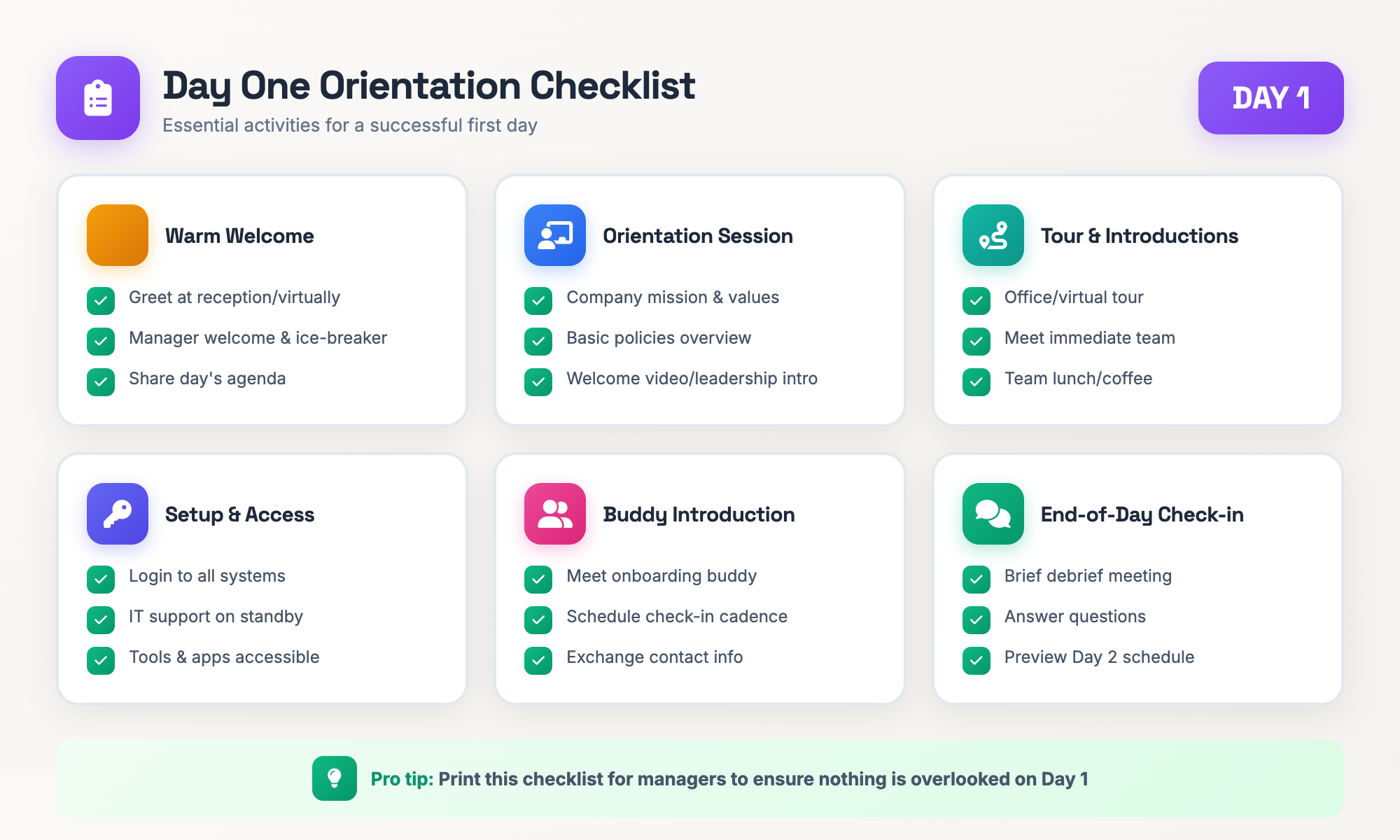
A Warm Welcome
The first moments matter most. Whether in-person or remote:
- Greet personally: Have the hiring manager or a designated team member ready at the door (or logged into the video call early)
- Workspace ready: Ensure their desk is clean, equipment is functional, and a small welcome item awaits (coffee mug, plant, or branded notebook)
- Agenda provided: Hand them a printed or digital schedule for the entire first day, nothing reduces anxiety like knowing what comes next
- Ice-breaker prepared: A brief, casual conversation about their weekend, commute, or interests before diving into logistics
Best Practice: Never leave a new hire waiting alone in a lobby or empty conference room. Those minutes feel like hours and send entirely the wrong message about how much you value them.
Orientation Session
Formal orientation sets the stage with key organizational background. Make it a session to be engaged in, not endured. Focus on these content areas:
- Company mission, vision, and strategic priorities
- Organizational history and culture highlights
- HR policies overview (attendance, time off, expense reporting)
- Safety procedures and emergency protocols
- Benefits summary and enrollment deadlines
- Compliance training requirements and schedules
Delivery Tips:
- Mix presentation with discussion, no more than 20 minutes of straight lecturing
- Include a short welcome video from executive leadership
- Use visual materials, not dense text
- Build in breaks every 45-60 minutes
- For remote employees, use interactive polls and chat engagement
Facility Tour & Team Introductions
Physical (or virtual) orientation to the workplace reduces the "lost newcomer" phenomenon:
In-Person Tours Include:
- Their workstation and nearby colleagues
- Restrooms, break rooms, and kitchen areas
- Emergency exits and safety equipment
- Key departments they'll interact with
- Informal gathering spots (the good coffee machine, the quiet focus room)
Team Welcome: Schedule a team lunch or coffee on day one. For remote teams, a casual video call where everyone shares something non-work-related creates immediate human connection. The goal is simple: help the new person see their colleagues as people, not just names on an org chart.
Setup & Verify Access
Technical friction on day one kills momentum. Make sure everything's working:
- Email accessible and configured
- Calendar showing correct meetings
- All required software installed and licensed
- VPN connected (for remote/hybrid)
- HRIS and payroll system access confirmed
- Project management tools provisioned
- Chat and communication platforms functioning
Have IT standing by (or at least have their number on speed dial) while you have a chance to earn that all-important good first impression in the first few hours. A laptop that won't connect or a password that won't work can turn it right upside down.
Buddy Introduction
The onboarding buddy becomes the new hire's lifeline for informal questions. Day one is when this relationship must activate:
- Formal introduction: Manager introduces the buddy and explains their role
- Private conversation: Buddy and new hire have 15-30 minutes alone to connect
- Expectations set: Buddy commits to daily check-ins during week one, transitioning to weekly thereafter
- Safe space established: Buddy explicitly invites "no question is too small" inquiries
Day One Checklist for Managers
Fill this out before your new hires' first days. Then be very, very positive.
- Greeted new hire personally upon arrival
- Workspace prepared and functional
- First-day agenda provided
- Orientation session completed
- Facility/virtual tour conducted
- Team introductions and welcome meal/call
- Systems access verified
- Buddy formally introduced
- Required paperwork finalized
- End-of-day check-in completed
- Tomorrow's expectations communicated
Now that the first day is behind you, the hard work that will make you competent begins. The next step is role-specific onboarding and integration.
Training & Role-Specific Integration (Phase 3)
The fanfare of a welcome falls silent after the first day. Now comes the real work: transforming the eager newcomer into a newcomer with competencies. This is the phase that will determine how quickly your new hire arrives at full productivity in the first weeks and months of the job. A systematic review of studies on the effects of onboarding interventions concluded that on-the-job training was more effective than other onboarding techniques to accelerate newcomer adjustment(source). In numerous studies, hires who received guided role immersion experienced quicker learning curves and improved adaptation into their roles versus hires who were left to their own devices.
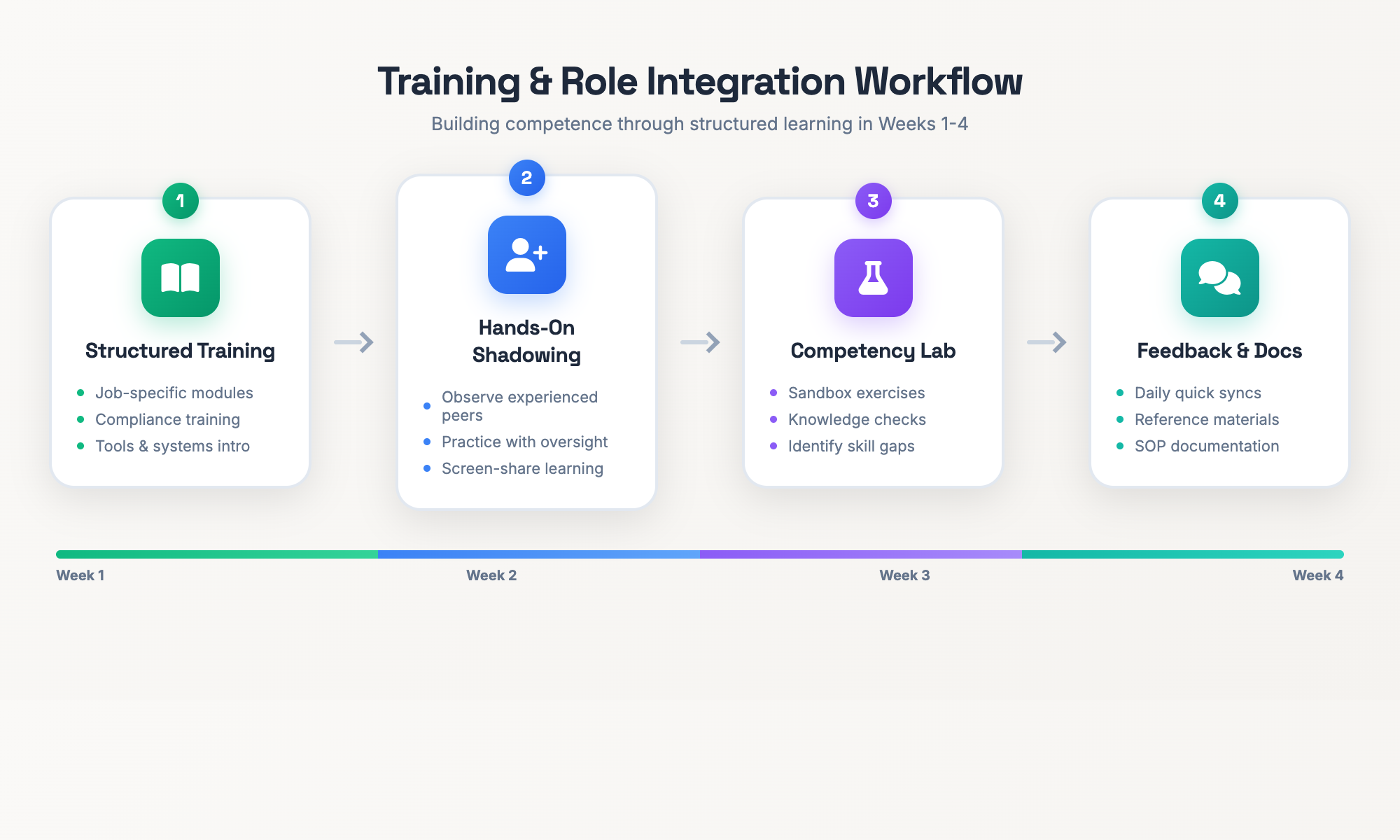
Structured Training Plan
“Generic training wastes everyone’s time” Create a targeted learning package for the role in question: “Week one focus:”
- Core systems training (tools they'll use daily)
- Required compliance modules (security, harassment prevention, data privacy)
- Introduction to team workflows and communication norms
- Shadowing key processes with experienced colleagues
Weeks Two through Four:
- Deep-dive into role-specific skills
- Progressive task ownership (supervised, then independent)
- Cross-functional introductions with collaborating teams
- Documentation review (SOPs, knowledge bases, process guides)
Warning: Information overload in week one is the fastest path to a disengaged new hire. Spread training across multiple weeks. The goal is retention, not exposure.
Shadowing & Hands-On Learning
Theoretical knowledge can only get someone so far. New employees must watch your work actually happen:
Do shadowing well.
- Assign 2-3 different colleagues for shadowing (not just one perspective)
- Brief the shadow hosts on what to demonstrate and explain
- Have the new hire take notes during observation
- Follow each shadowing session with discussion time for questions
- Transition from "watch and learn" to "do with guidance" within the first two weeks
Competency Assessment Lab
How do you know if training is working? Most organizations guess, or wait for problems to occur. A better approach builds low-stakes evaluation checkpoints through the duration of the learning period. Think of this as a kind of practice environment where new hires demonstrate skills before the stakes are fully on the line. Structure this around needs of the role. For Technical roles
- Sandbox environment to complete a sample task
- Code review of a practice pull request
- Configuration of a test system with specific requirements
For Customer-Facing Roles:
- Mock customer interaction with feedback
- Sample ticket resolution in a training queue
- Role-play of common objection handling
Assessment Micro-Checklist:
After each competency check, evaluate:
- Task completed accurately?
- Reasonable time to completion?
- Correct resources and references used?
- Questions asked appropriately (neither too many nor too few)?
- Confidence level self-assessed by new hire?
This framework spotlights knowledge gaps in advance, before they become performance problems, and provides evidence of progress to new hires and builds their confidence.
Feedback Loops While Training
Your learning rate spikes when you receive regular feedback. Find these feedback rhythms. Daily (Week One):
- Five-minute end-of-day check-in
- Quick pulse on confusion points and wins
- Immediate clarification of misunderstandings
Weekly (Weeks Two through Eight):
- 30-minute structured one-on-one
- Review of training progress against plan
- Discussion of questions and obstacles
- Adjustment of pace based on demonstrated competence
Continuous:
- Open channel for questions (Slack/Teams, or in-person availability)
- Explicit encouragement that asking questions is expected
- Manager visibility into training module completion
Best Practice: When new hires hesitate to ask questions, they're not learning, they're pretending. Create psychological safety by celebrating good questions and admitting when you don't know the answer yourself.
Once you've got the technical competence down, the second part of the job is to integrate. Let's dig into the social.
Social Integration & Team Embedding (Phase 4)
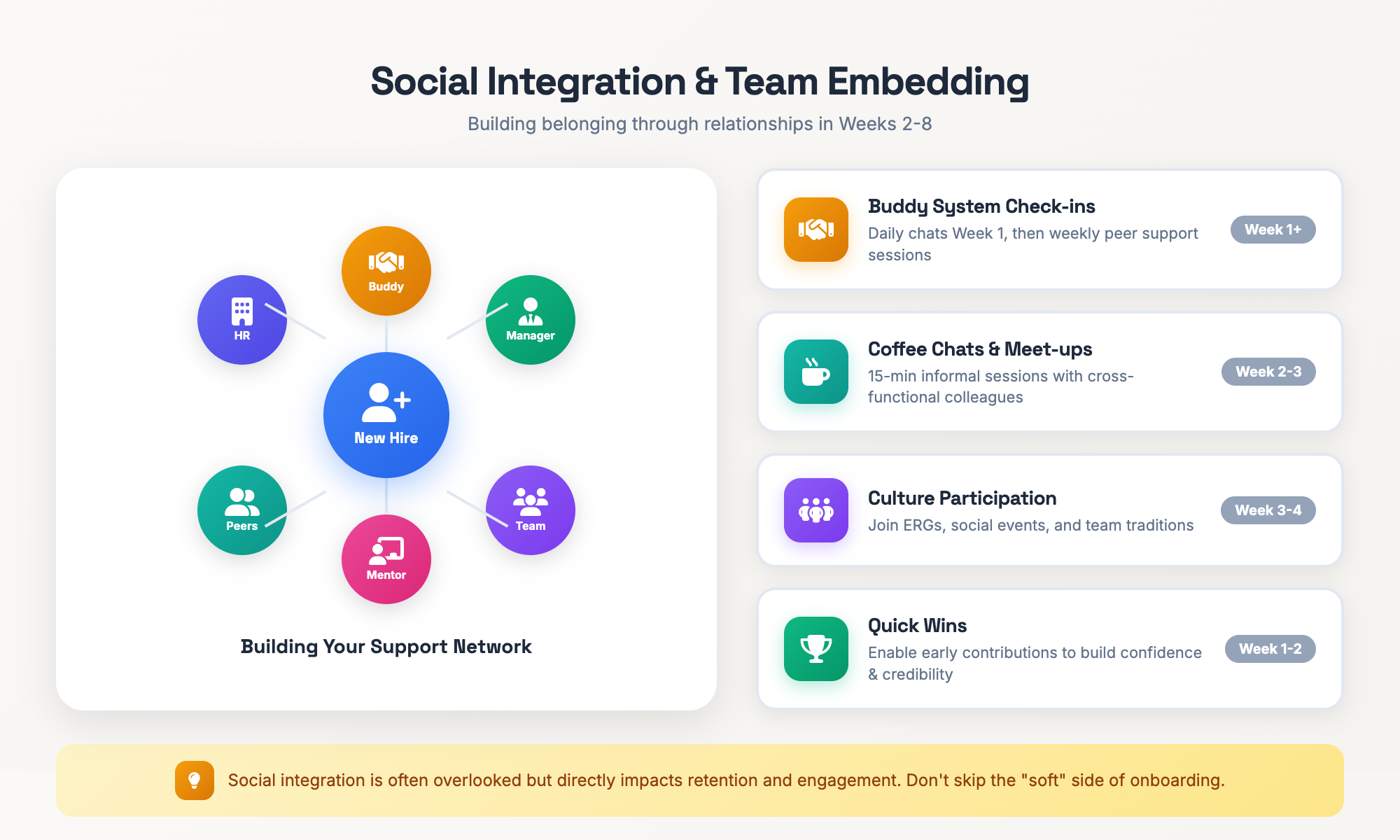
When competent people join your team but don’t build connections, they feel like outsiders with skills. It is this social part of onboarding—often undervalued and overshadowed by task-based training—that determines whether someone joins your organization or occupies a job at it. Research on organizational socialization tells us that newcomers who proactively seek relationships and build peer networks are more committed to the organization and adapt more quickly(source). Team integration is not just a 'nice to have.' It's necessary for longer-term retention of engaged team members. Many contemporary onboarding frameworks utilize the 4 Cs framework: Compliance, Clarification, Connection, and Culture(source). This phase addresses the last two, ensuring that newcomers feel they belong and learn the "how things work round here."
Buddy System & Mentor Check-Ins
Your onboarding buddy relationship should grow, not ghost you. Keep it organized: Week One (Daily Touchpoints):
- Brief morning check-in: "Any questions from yesterday?"
- Lunch or coffee break together
- End-of-day availability for accumulated questions
Weeks Two through Four (Every Other Day):
- Scheduled 15-minute touchpoints
- Introduction to additional colleagues
- Cultural context for upcoming meetings or events
Month Two Onward (Weekly):
- Longer conversations about role challenges
- Honest feedback on how things are really going
- Transition toward peer relationship rather than support relationship
Key Insight: The best buddies aren't necessarily the most senior. Choose colleagues who are approachable, patient, and genuinely invested in helping newcomers succeed. Enthusiasm matters more than tenure.
Team Introductions & Coffee Chats
Expand the new hire's network deliberately beyond their immediate team:
Structured Networking Schedule:
- Week one: Immediate team members (depth over breadth)
- Week two: Adjacent team colleagues they'll collaborate with
- Weeks three and four: Cross-functional stakeholders
- Month two: Leadership exposure where appropriate
Coffee Chat Format: Keep these conversations light and relationship-focused:
- 15-20 minutes maximum
- Virtual or in-person depending on location
- Suggested topics: background, current projects, advice for new team members
- No pressure to discuss work deliverables
For remote teams, schedule these intentionally. They won't happen organically without calendar invites. Consider using a random pairing tool to encourage connections across department boundaries.
Quick Wins and Contributions
A feeling of belonging deepens as newcomers pitch in. Facilitate quick wins: Good quick-win tasks…
- Completable within the first two weeks
- Visible to the team
- Genuinely useful (not make-work)
- Appropriate complexity for current skill level
Examples by Role Type:
- Developer: Fix a minor bug or improve documentation
- Marketing: Draft copy for an upcoming campaign element
- Operations: Update a process document with fresh perspective
- Sales: Research and present on a prospect or competitor
- Support: Resolve a training-queue ticket independently
When a new hire makes their first real contribution, acknowledge it publicly. Slack message, standup mention, thank-you email that you carbon-copy the team on. These little recognitions say: "You're one of us."
With the social foundation laid, the next step is to connect expectations with the final stage for tracking success.
Performance Alignment & 30-60-90 Day Roadmap (Phase 5)
Training develops skills. Social integration creates belonging. But without expectations for performance, new hires find themselves in a fog, unsure whether they are doing what the organization needs to do. Studies show that new hires who report "low role ambiguity" post onboarding score significantly higher on task performance(source). When staff know what "success" looks like, they perform better. This is exactly what the 30-60-90 day roadmap achieves through timely milestones and regular checkpoints.
Goal Setting (30/60/90 Days)
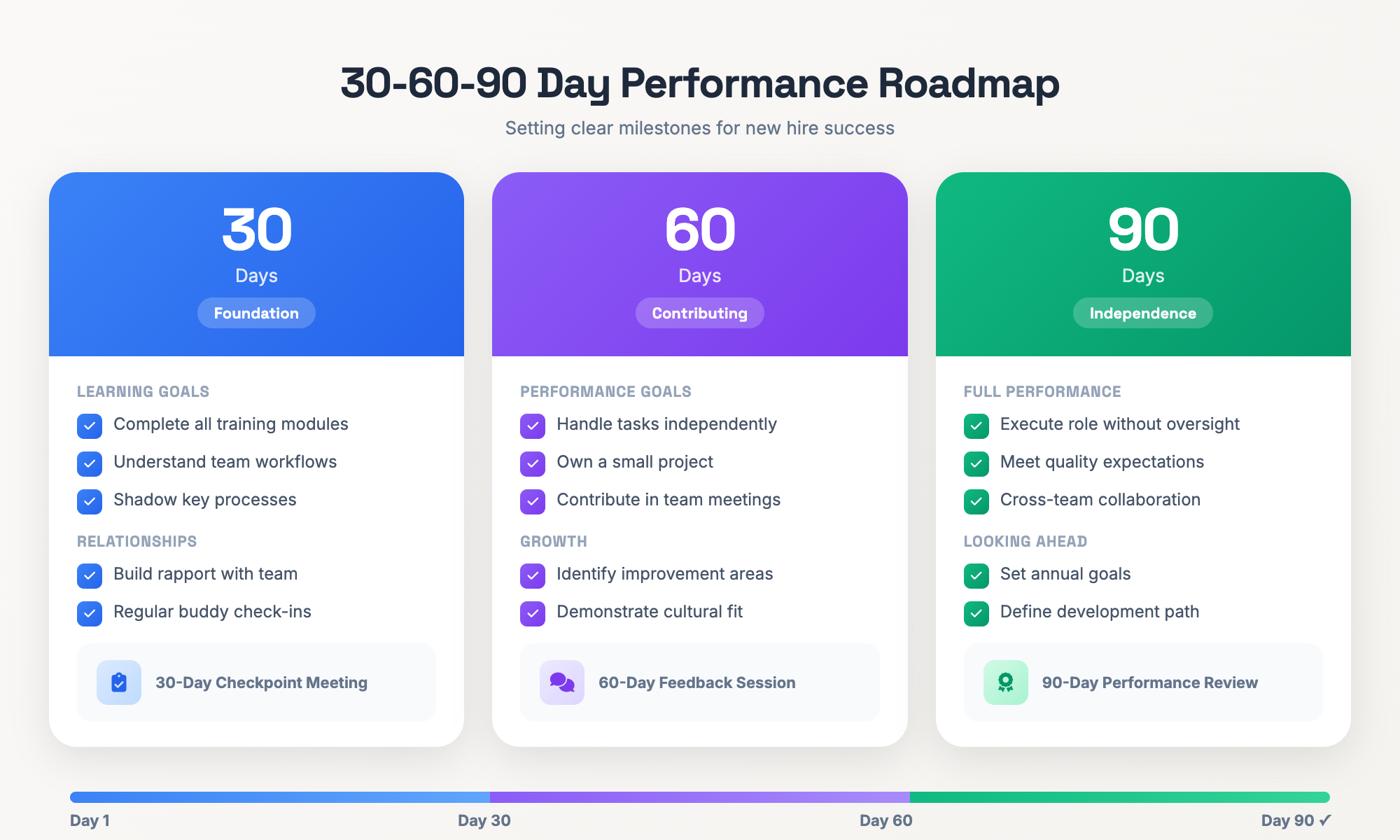
Vague expectations produce vague results. Work with your new hire to define what they should be doing in their first quarter: 30-Day Milestone (Foundation). Focus: Learning and observation.
- Complete all required training modules
- Understand team workflows and communication patterns
- Build relationships with immediate colleagues
- Shadow key processes end-to-end
- Ask informed questions based on initial learning
60-Day Milestone (Contributing Phase): Focus: Supervised productivity
- Handle routine tasks independently
- Take ownership of a small project or initiative
- Provide input in team discussions and planning
- Identify one process improvement opportunity
- Demonstrate growing familiarity with organizational culture
90-Day Milestone (Independence Phase): Focus: Full role execution
- Perform core job functions without daily supervision
- Manage standard workload at expected quality level
- Collaborate effectively across team boundaries
- Contribute meaningfully to team objectives
- Articulate personal development priorities for the coming year
Key Principle: Goals should be collaborative, not imposed. When new hires participate in defining their milestones, they own them. Manager-dictated goals feel like performance tests. Co-created goals feel like a shared roadmap.
30-60-90 Day Planning Template.
Download: 30-60-90 Day Plan Template - Templates to help managers and new hires document expectations, track progress, and capture checkpoint outcomes.
30-Day Review
The first formal review is a kick the tires and look under the hood session that covers: Discussion Topics:
- Training completion status and knowledge gaps
- Comfort level with team dynamics and culture
- Clarity on role expectations (what's still unclear?)
- Resource adequacy (tools, information, access)
- Relationship with buddy and manager
- Self-assessment of progress
- Adjustments needed for the next 30 days
Best Practice: Send the checkpoint agenda 48 hours in advance. Surprises in performance conversations create anxiety. Preparation creates partnership.
60-Day Progress & Feedback
By now, you should see the new hire contributing. This checkpoint should be devoted to both patting him on the back and setting him straight. Emphasize:
- Progress toward 60-day performance goals
- Quality of independent work output
- Integration into team collaboration patterns
- Emerging strengths to leverage
- Development areas requiring additional support
- Alignment between expectations and reality
Two-way feedback matters. Solicit the feedback from the new hire on what the organization could differently do to be more successful. They may see things that are invisible to the tenured team members.
90-Day Performance Review
This marks the end of “onboarding” in its true sense, after which you should be an ongoing employee. Review components:
- Goal achievement assessment against 90-day plan
- Overall performance evaluation (meets expectations, exceeds, developing)
- Feedback on core competencies relevant to the role
- Recognition of specific accomplishments
- Development priorities for the next quarter
- Career conversation: interests, growth aspirations, support needed
Download: Onboarding Timeline - All steps from preboarding to 90-day review, with compliance due dates and checkpoint schedules all included. With the performance expectations set, how do you keep the onboarding program alive and make it even better? The fifth and final phase focuses on governance and continuous improvement.
Onboarding Governance & Continuous Improvement (Phase 6)
Onboarding doesn't end at 90 days, and neither should your focus on it. The strongest onboarding programs keep evolving, taking advantage of data, insights, and changing organizational needs as input. This governance process is where onboarding transitions "from a one-time event to an ongoing system that improves with every new hire. A well-documented onboarding policy and procedure provides for consistent onboarding across departments and a basis for continual refinement." Organizations who take on onboarding as a measured, managed process, see 70% "of new hire's best efforts come during onboarding" and companies who don't see the opposite – "billions of dollars per year wasted due to increased turnover and reduced productivity ramp-up." Studies show that new hires who participate in a thorough onboarding process are 69% more likely to stay with the company for three years or longer(source). Organizations with an inconsistent onboarding program waste billions annually from early turnover and long ramp-up to productivity.
Extended Checkpoints (6, 9, 12 Months)
While formal onboarding may have wrapped up at 90 days, there’s still work to be done to grow that relationship between employee and organization. Schedule governance touchpoints beyond the first 90 days: Six Month Check-in:
- Full integration assessment: Does the employee feel like a complete member of the team?
- Skills gap identification: Where does further development remain needed?
- Onboarding retrospective: What worked well? What could have been better?
- Career conversation: Are initial expectations matching reality?
One-Year Anniversary:
- Comprehensive performance review
- Formal onboarding program feedback collection
- Discussion of advancement opportunities
- Celebration of the milestone achieved
Measuring Success - KPIs for Onboarding
You can't improve what you don't measure. Setting the right metrics will show if your onboarding program is actually working.
Core Onboarding Metrics
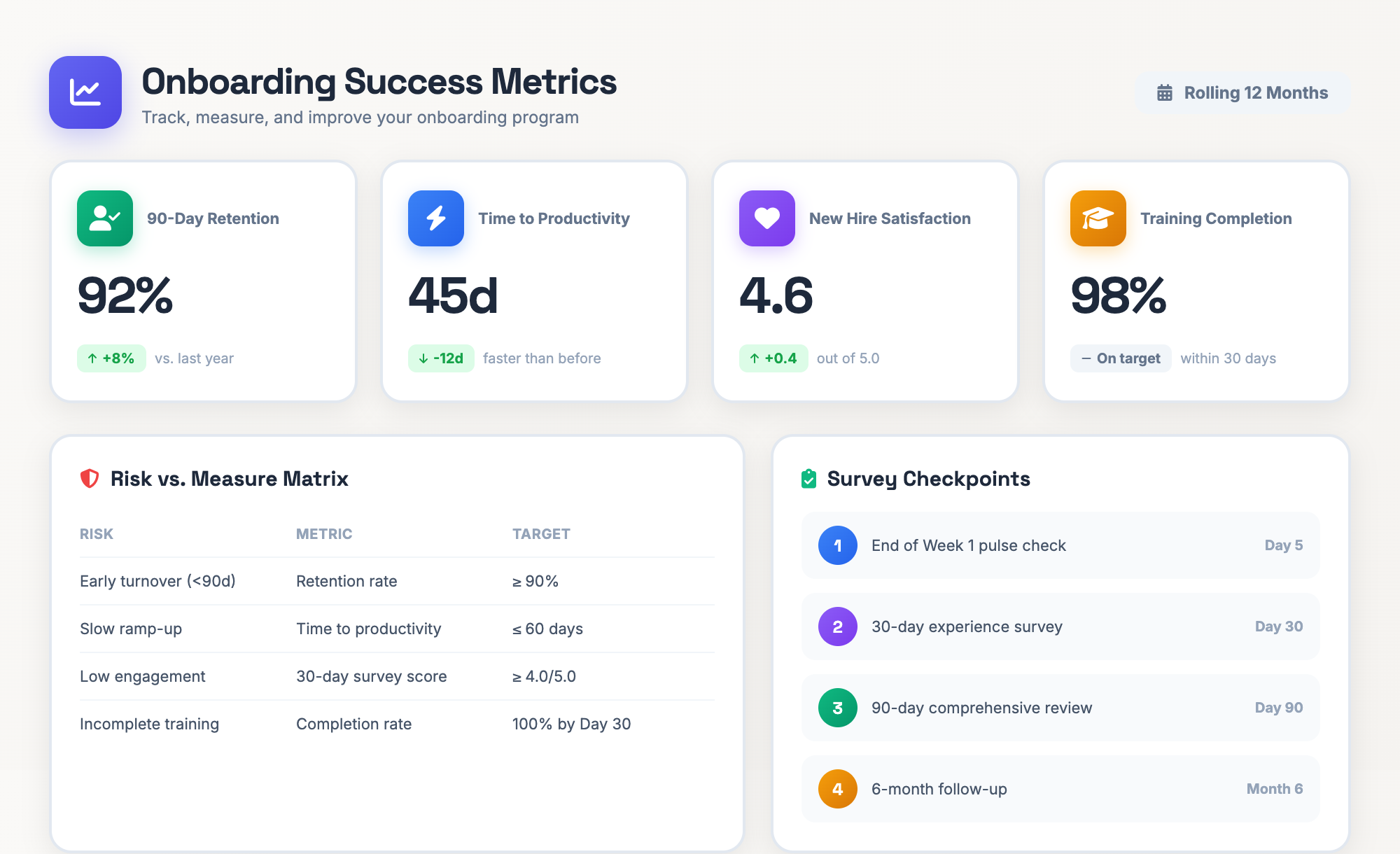
Time to productivity: how many days until the new hire can perform in their role to a satisfactory level. Target example: 60-90 days (longer for 'deep dive' roles) 90-day retention rate (% of hires that stay more than their probation). Target example: 95%+ Training completion rate (% of new hire training modules completed on time). Target example: 100% in 30 days Satisfaction score (% rating new hire training as a good experience [average out of 5])• Manager. Target score: 4.0+ Buddy program. Target score: 4.0+
Warning: Metrics without action are just numbers. Establish thresholds that trigger investigation. If 90-day retention drops below 85%, that's not just a statistic, it's an alarm requiring immediate analysis.
New Hire Feedback
Collect feedback at several intervals: Onboarding Checklist
Feedback Collection Timing
End of Week 1 Short feedback pulse survey (5 questions)—Focus on new hire’s first impressions and immediate needs not well addressed. Day 30 Thorough survey (15-20 questions)—Training, Buddy, Manager, and Clarity style questions. Day 90 An exit-from-onboarding survey—How well did the new hire’s onboarding work? Finally, what might we consider for the next hire? Day 180 Retrospective interview or survey—Why did this hire stay? What impacted their lasting performance?
Sample survey questions
- "I had the information I needed to do my job effectively" (1-5 scale)
- "My buddy was helpful and available" (1-5 scale)
- "Training prepared me for my actual responsibilities" (1-5 scale)
- "I feel like a valued member of the team" (1-5 scale)
- "What was the most valuable part of your onboarding?"
- "What would you change about the onboarding experience?"
Iterate and Improve
Feedback without action breeds cynicism. Schedule a consistent cadence for improvement: Quarterly review:
- Analyze onboarding metrics trends
- Review survey feedback themes
- Identify top three improvement opportunities
- Assign ownership and timelines for changes
Annual Program Audit:
- Comprehensive assessment of all onboarding components
- Benchmark against external best practices
- Update content for organizational changes
- Refresh training materials and checklists
- Recalibrate metrics targets based on performance
Best Practice: Treat your onboarding program as a product with a continuous improvement roadmap. Version it, track changes, and celebrate improvements publicly.
Download: Onboarding Metrics Tracker - A ready-made spreadsheet for tracking new hire progress, automatically calculating key metrics, and showing trends over time. Download: Best Practices Guide - A reference doc that contains everything proven to optimize any aspect of onboarding.
With the right governance, an onboarding program becomes self-improving; how can tech aid all that documentation's creation and upkeep?
How Hinto AI Simplifies Onboarding Documentation
Crafting the checklists, training materials, and standard operating procedures that fuel successful onboarding requires a significant upfront investment of time. Recording a process, taking screenshots, writing step by step instructions, making everything consistent—these tasks multiply as your organization grows. Enter Hinto AI: a way to turn screen recordings into smart, indexed multi-article knowledge bases. A version history means you'll be able to see how your documents changed through time, so you don't have to rewrite your onboarding as your processes change.
Frequently Asked Questions
What's the difference between onboarding and orientation?
Orientation usually means the actual first day or the first few days of a new hire's experience, with paperwork, introductions, and basic company information. Onboarding is a longer-term, multi-month experience that includes orientation, training, social integration, performance alignment, and ongoing support. You can think of orientation as one event in the series of many onboarding has to offer. Great organizations know a one-time event does not accomplish what a practical onboarding experience of 90-days or more can.
How long should the onboarding process take?
Most studies show that proper onboarding takes at least 90 days—with some companies continuing to provide formal support throughout the first year! The first 30 days are primarily about learning the ropes, settling in, and figuring out what you want. Days 31-60 are where contributing productivity takes precedence. Days 61-90 focus on gaining independence. After 90 days, governance checkpoints at 6 months and a year help to measure progress and ensure deeper integration while providing at least a little support for lingering development goals. Exactly how long onboarding should take depends on each role, but rushing onboarding is invariably worse than extending it.
How can we measure onboarding success?
Monitor metrics at various levels of granularity: time to productiveness (how rapidly new hires ascend to competency), 90-day and first-year retention rates, training completion percentages, new hire survey satisfaction scores, manager assessment of new hires' readiness to be let loose, buddy program effectiveness. Helpful advanced metrics include the distribution of performance ratings for new hires vs. tenured employees and their time to first promotion, and internal referral of others by a recent hire for this team. Track baseline metrics before you begin changing things so that you can measure the improvement.
What role does the hiring manager play in onboarding?
Your hiring manager is ultimately the person responsible for your success. They should:
• Take part in any preboarding welcome communication • Be present and welcoming on day one • Set expectations and goals for your performance • Conduct regular check-ins and conversations about how to best onboard you • Introduce you to people you need to know • Ensure training addresses what you actually need to do your job • Facilitate relationships with your buddy and mentor • Conduct formal checkpoints at 30, 60, and 90 days, etc.
The content of your onboarding will be provided by HR, but your manager will be delivering the day-to-day execution.
What makes a good onboarding buddy?
Buddy-up with the most approachable people possible, the ones who will put time in to help newbies get settled—and hopefully avoid a couple unnecessary pit falls along the way.
The best buddies are patient and unhurried; interested in helping their new colleagues succeed. They've been around long enough to understand the culture and the ropes, but not so long that they've lost the ability to remember what it's like to be new. They are available to answer questions during the push-and-shove of the first weeks. They're enthusiastic not senior.
Train your buddies briefly on what you are expecting from them (ex: conversation starters, how to escalate issues). Rotate buddy assignments every few weeks, and you'll mitigate the risk of buddy burnout and encourage people across the team to build a healthy set of relationships.
What is a 30-60-90 day plan and why is it important?
30-60-90 plans set expectations for a new hire's first three months of the job: 30 days for learning, 60 days for contributing under direction, and 90 days for independent performance. This level of clarity about what success looks like gives the manager and new hire natural points to check in and have feedback conversations, and it also helps the new hire see if they're winning or if things have gone off track. Without this kind of plan, expectations are fuzzy, underperformance is condoned, and new hires have no idea if they are passing or failing.
Conclusion & Next Steps
A great onboarding process changes scared new employees into brave productive long-term team members. What separates companies with high turnover from those that retain their talent and accelerate it to success most often comes down to the first 90 days. This blueprint has mapped the journey of onboarding: preboarding engagement to amp excitement, day-one orientation to instill belonging, training to build competence, social integration to forge connection, performance alignment to establish clarity, and governance systems to close the loop on learning. Each step builds on the previous, and together they carry new hires from where they are — unsure outsiders — to where you need them to go — invested insiders.
Remember: creating effective onboarding isn't an end goal, but a constantly evolving commitment to every new hire. Pick one phase, test it, track and get feedback, make it better, and repeat. Small changes compound. Your next hire deserves a better experience than your last one did.
References
- Chillakuri, B., & Mahanandia, R. (2022). Onboarding during COVID-19: Create structure, connect people, and continue adapting. IEEE Engineering Management Review, 50(3), 162-167. DOI: 10.1109/EMR.2022.3183589. Available at: https://pmc.ncbi.nlm.nih.gov/articles/PMC9190770/
- Coutifaris, C. G. V. (2022). The early bird conveys the culture: The effects of preboarding practices on newcomer socialization and performance (Doctoral dissertation, University of Pennsylvania). Available at: ResearchGate
- Capitano, J., & Gesualdi, M. (2025). Organizational communication during pre-boarding: An examination of new hire communication frequency, organizational commitment, and job satisfaction. International Journal of Business Communication. Advance online publication. DOI: 10.1177/23294884251326250. Available at: https://journals.sagepub.com/doi/10.1177/23294884251326250
- Raub, S., Borzillo, S., Perretten, G., & Schmitt, A. (2021). New employee orientation, role-related stressors and conflict at work: Consequences for work attitudes and performance of hospitality employees. International Journal of Hospitality Management, 94, 102857. DOI: 10.1016/j.ijhm.2020.102857. Available at: https://www.sciencedirect.com/science/article/pii/S0278431920304096
- Mahmood, M., Ostrovskiy, A., & Capar, N. (2023). Effect of orientation training on employee and firm performance. Global Business and Organizational Excellence, 42(4), 49-62. DOI: 10.1002/joe.22173. Available at: https://onlinelibrary.wiley.com/doi/10.1002/joe.22173
- Mitschelen, A., & Kauffeld, S. (2025). Workplace learning during organizational onboarding: Integrating formal, informal, and self-regulated workplace learning. Frontiers in Organizational Psychology, 3, Article 1569098. DOI: 10.3389/forgp.2025.1569098. Available at: https://www.frontiersin.org/journals/organizational-psychology/articles/10.3389/forgp.2025.1569098/full
- Frögéli, E., Jenner, B., & Gustavsson, P. (2023). Effectiveness of formal onboarding for facilitating organizational socialization: A systematic review. PLoS ONE, 18(2), e0281823. DOI: 10.1371/journal.pone.0281823. Available at: https://journals.plos.org/plosone/article?id=10.1371/journal.pone.0281823
- Yozgat, U., & Güngörmez, D. (2015). The mediating role of social integration on the effect of proactive socialization tactics applied by newcomers on their organizational commitment. Procedia – Social and Behavioral Sciences, 207, 462-471. DOI: 10.1016/j.sbspro.2015.10.116. Available at: https://www.sciencedirect.com/science/article/pii/S1877042815052490
- Chillakuri, B., & Mahanandia, R. (2022). [Referenced from SHRM industry data on onboarding costs]. IEEE Engineering Management Review, 50(3), 162-167. Available at: https://www.ncbi.nlm.nih.gov/pmc/articles/PMC9190770/
- U.S. Office of Personnel Management (OPM). (2011). Hit the Ground Running: Establishing a Model Executive Onboarding Framework. Washington, DC: OPM. Available at: https://www.opm.gov/policy-data-oversight/training-and-development/hit_the_ground_running_establishing_a_model_executive_onboarding_framework_2011.pdf

Product updates, feature announcements, and best practices from the Hinto product team.
Ready to Build a Better
Knowledge Base, Faster?
Get Started Free & Create Your First Article in Minutes