
IDS in EOS: The All-Inclusive Guide to L10 Meetings and Solving Problems
How often does your leadership group have a meeting where nothing happens? Each week the same issues arise, and discussions go around in circles without being resolved, leaving everyone feeling dissatisfied. If this sounds familiar to you, you’re not the only one.
The Entrepreneurial Operating System (EOS) offers two related tools to take those endless discussions and turn them into decisive results: the IDS process (Identify, Discuss, Solve) and the Level 10 meeting. When used together, they result in meetings that solve problems and improve team effectiveness.
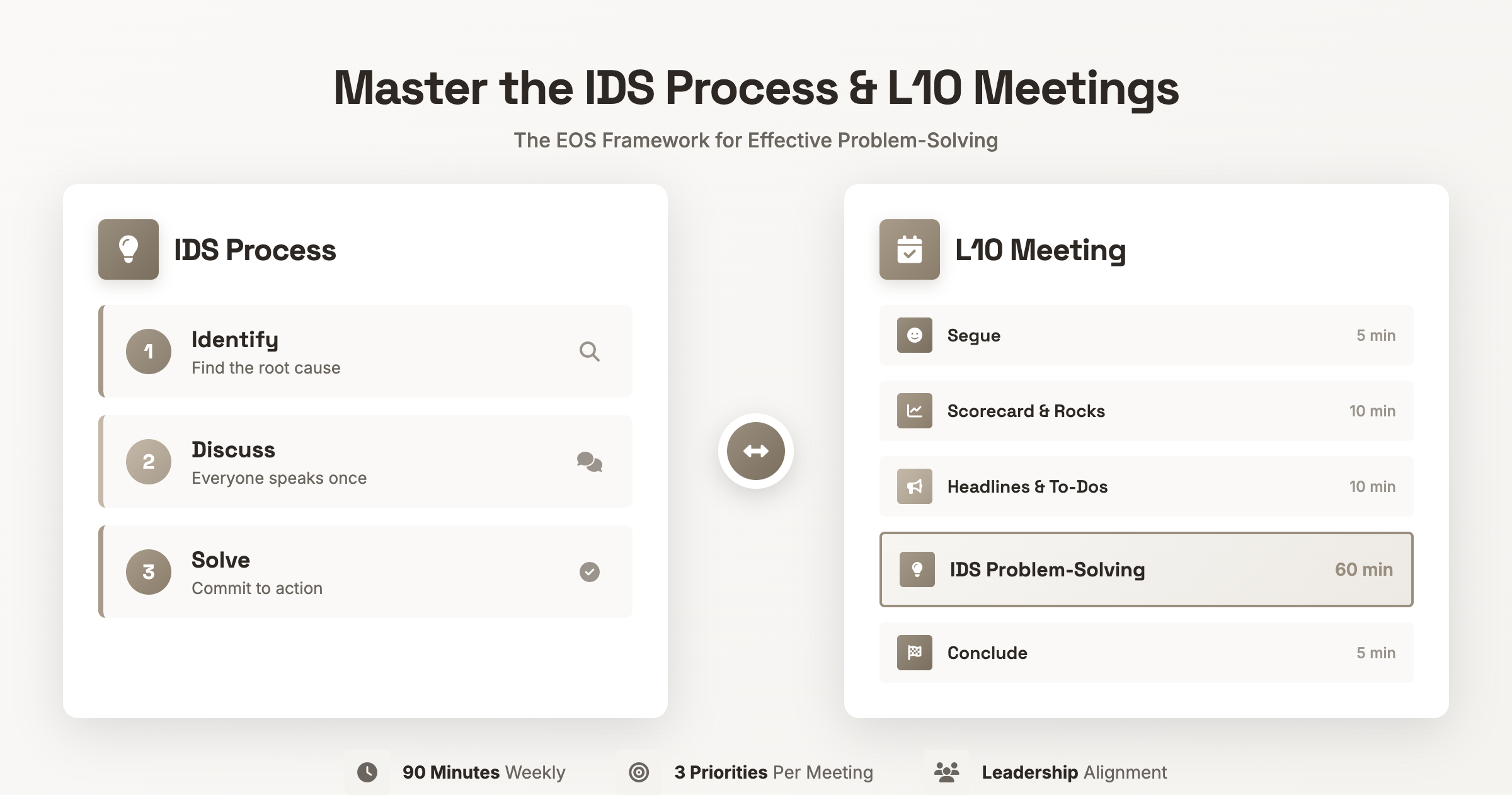
This guide lays out what the acronym "IDS" means, as well as how the L10 meeting format works and how to implement both of these correctly.
What Does IDS Stand For in EOS?
In EOS, IDS stands for Identify, Discuss, Solve and is the foundational methodology for problem-solving within the Entrepreneurial Operating System. It is a disciplined approach that requires teams to address issues in a structured way, avoiding the typical problem of having discussions about issues without resolving the issue; otherwise they would continue to discuss the same issue over and over with no resolution.
To understand how this process is structured, think of the IDS Process as being a funnel; at the top of the funnel go in all of your unpleasant, undefined frustrations. The funnel's design ensures that only clear, actionable resolutions come out of the bottom of the funnel. Without this funnel design, most teams would go instantly from discussing the symptoms of an issue to ignoring the actual issue while it continued to worsen.
In practical terms, IDS means no more meetings where the same issue is discussed five times in a row; implementing structured problem resolution will produce documented subsequent actions and more importantly, will result in the identification and resolution of the underlying cause of the issue rather than treating the symptoms of the issue which will just come back later.
The Three Phases of IDS Explained
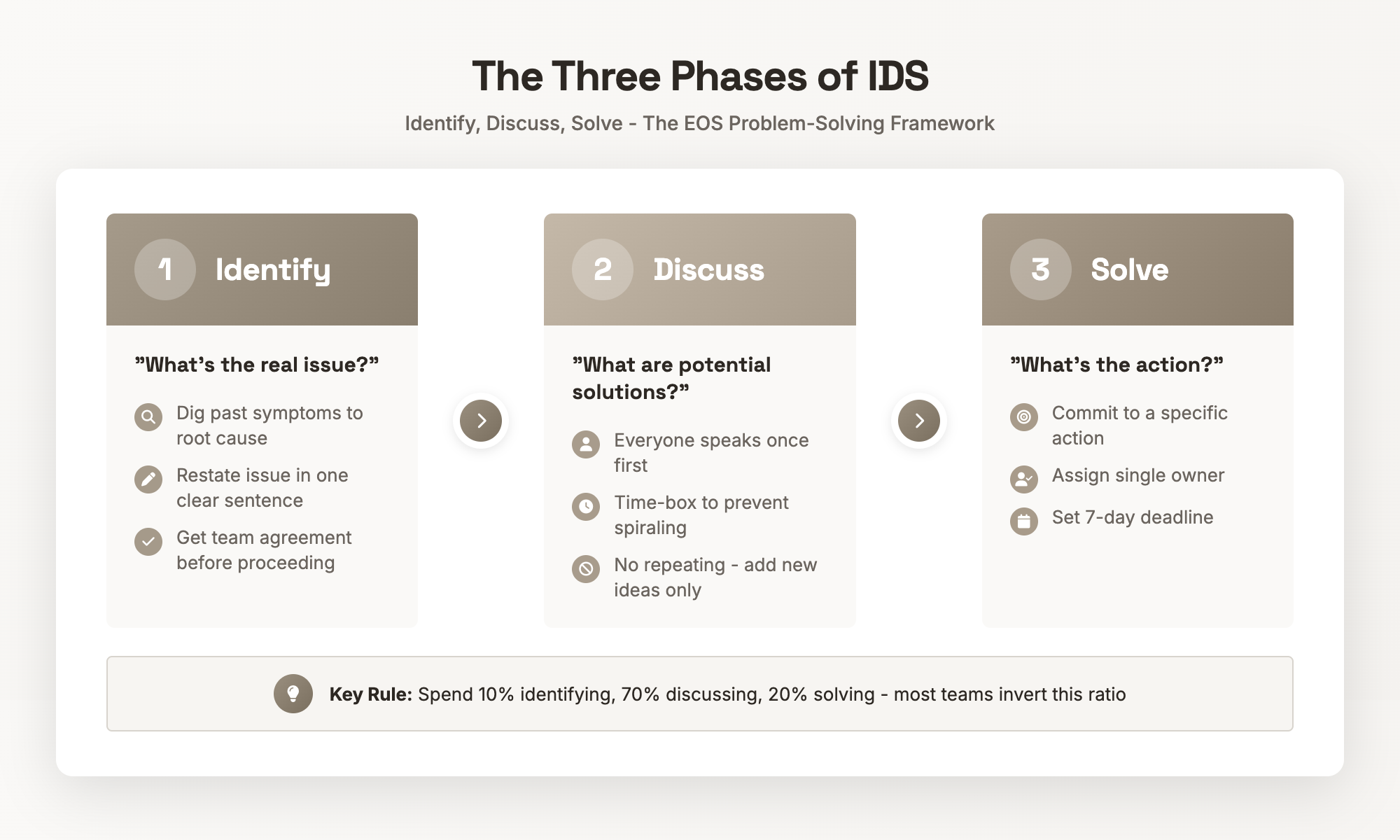
Each step of the IDS process (identify, discuss, solve) has a prescribed purpose.
Phase 1: Identify (10% of IDS Time)
The only question answered in the identification phase is: What is the real issue here? The person who identified the issue will provide a high-level description of the issue and then the team will dig deeper into it by asking clarifying questions until they get to the underlying root cause.
Practical Tip: Write the identified issue in one clear sentence before moving on. If you are not able to explain it in clear terms, you still have not identified the true issue.
Phase 2: Discuss (70% of IDS Time)
Where most teams get it wrong is by thinking that discussion means everyone gets to share their opinion in turn. This is not discussion; it’s called a talking circle. The EOS ids process requires focused discussion; meaning all participants work off each other’s contributions with the intention of moving toward a resolution.
A productive discussion follows three rules:
- Everyone speaks once before anyone speaks twice
- Stay on topic—tangents get added to the issues list
- Debate ideas, not people—depersonalize the issue
It's normal for the group to experience a little uneasiness while talking through an issue. If a group reaches an agreement quickly, it's likely that the group did not delve deep enough into the subject matter. Constructive conflict during discussions will produce higher quality resolutions.
Phase 3: Solve (20% of IDS Time)
The Solve Phase consists of about 20% of an IDS Session's duration. Solving means either making a decision or committing to take action. Therefore, an IDS Session will create:
- A specific action item to be assigned to a person by a deadline;
- Or a decision that permanently resolves the issue; or
- Or eliminating the issue.
The solve phase identifies the specific person who is responsible for the execution of the resolution. If no one owns the resolution, no matter how great it may be, that resolution will become everyone's issue.
📥 Download: IDS Session Checklist (PDF) - Timing, questions, and completion criteria for each phase
Why the Stated Problem is Not the Real Problem
In order to successfully perform a root-cause analysis in IDS, you have to “peel the onion” by repeatedly asking why until you come across something that is actionable. The process of identifying a problem would look something like this: Why aren’t we meeting quota? ⇒ Because close rates have fallen off. ⇒ Why have close rates fallen off? ⇒ Because there is a new competitor who is offering lower prices. ⇒ Why is the competitor winning business at that price? ⇒ Because our value proposition is not different enough from theirs. At that point, we now have a problem to solve.
This type of thinking is important because reducing human error is a result of making SOPs clearer, and issue identification is no different. If the problem statement is vague, the solution will be misdirected as well.
The Cold Medicine Fallacy: Treating symptoms will provide short-term relief, but the underlying problem will still exist and re-occur. If you keep “solving” the same problem over and over again, you are treating a symptom with cold medicine; you should be treating the root cause of that symptom.
📥 Download: IDS Root Cause Analysis Worksheet (PDF) - 5 Whys framework and fishbone diagram template
The three categories of issues that appear on your EOS issues list represent very different issues. Understanding the types of issues in your EOS system will enable you to allocate time effectively when working with issues.
1. Problems are barriers or obstacles preventing a team from moving forward. Examples of these issues include a broken piece of equipment, a team member who has failed to carry out their responsibilities, or an ineffective process that is not working. By way of example, some things that can be classified as problems would include an employee who has threatened to leave, the deterioration of a customer relationship, or an operational bottleneck creating missed deadlines. Problems require the full process of the IDS, which includes determining the root cause (I), discussing potential solutions (D) and agreeing to take action (S). If you attempt to rush through the process of solving problems, there is a good chance that you will have to continually repeat the same process.
2. Information will be shared rather than solved. For example, a team member might need additional information from you before they are able to make a decision, or you might want to draw attention to a trend without proposing a solution. Rarely will you find that these need devoted time to extensive discussion. The (I) phase is where the member clarifies to everyone else what he or she is sharing, the (D) phase is typically a brief discussion to confirm that everyone understands what has taken place, and the (S) phase is often simply acknowledging what has taken place and moving on.
3. Ideas and Opportunities are forward-thinking possibilities for your organisation to explore. Examples of ideas and opportunities are new market opportunities, suggestions for process improvements and strategic initiatives. While these are not problems (because nothing is broken), they do represent a potential for additional value and need to be dealt with in an organized manner. When working on these types of issues, the team will evaluate the idea's feasibility and timing but will not evaluate what went wrong. The (S) phase for solutions for ideas and opportunities may include placing the idea on the Vision/Traction Organiser for quarterly planning/workload, or by assigning someone to conduct further research on the idea.
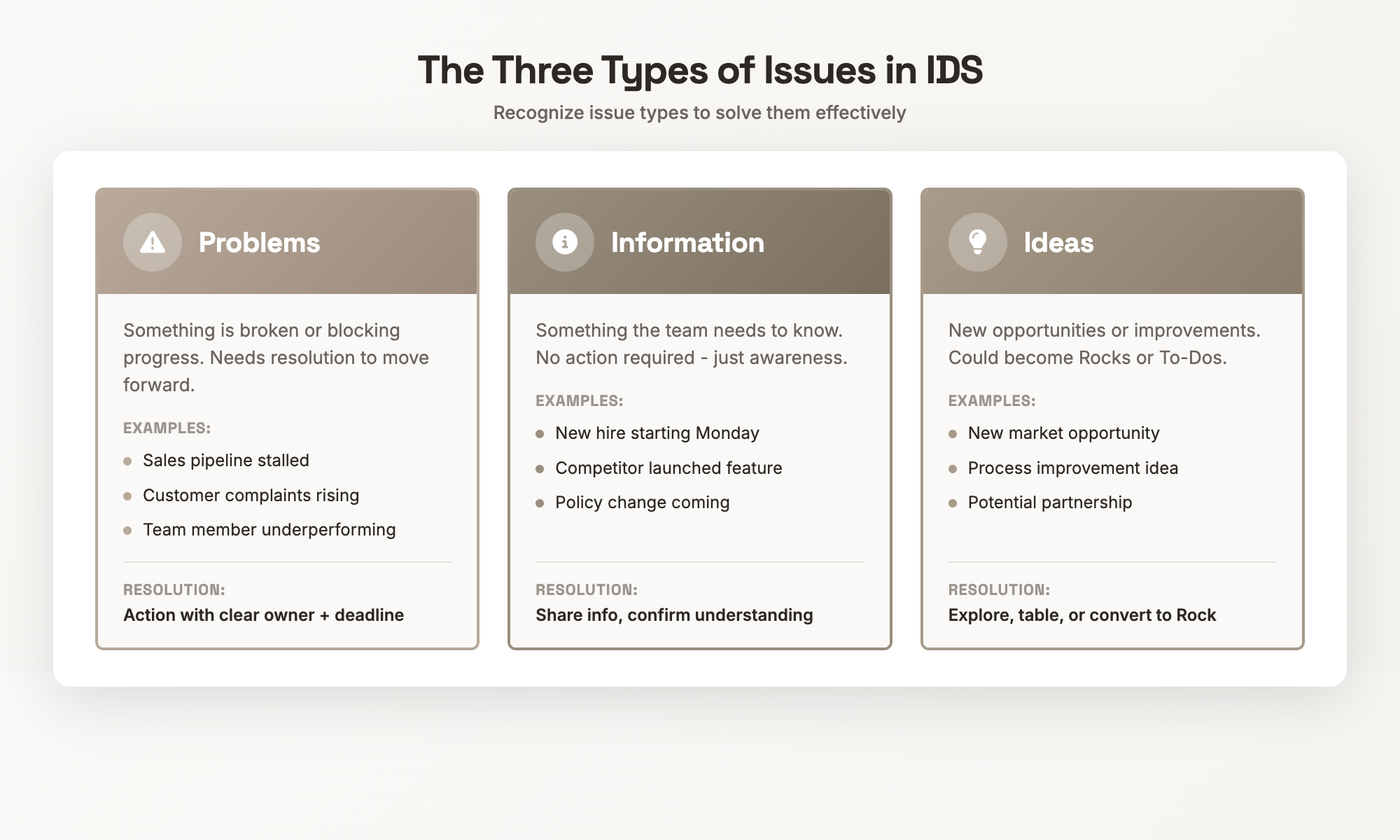
Pro tip: Before starting IDS, have the person declare the category: "This is a problem," "This is information," or "This is an opportunity." That classification calibrates how much time to invest.
Creating an Issues List and Managing It
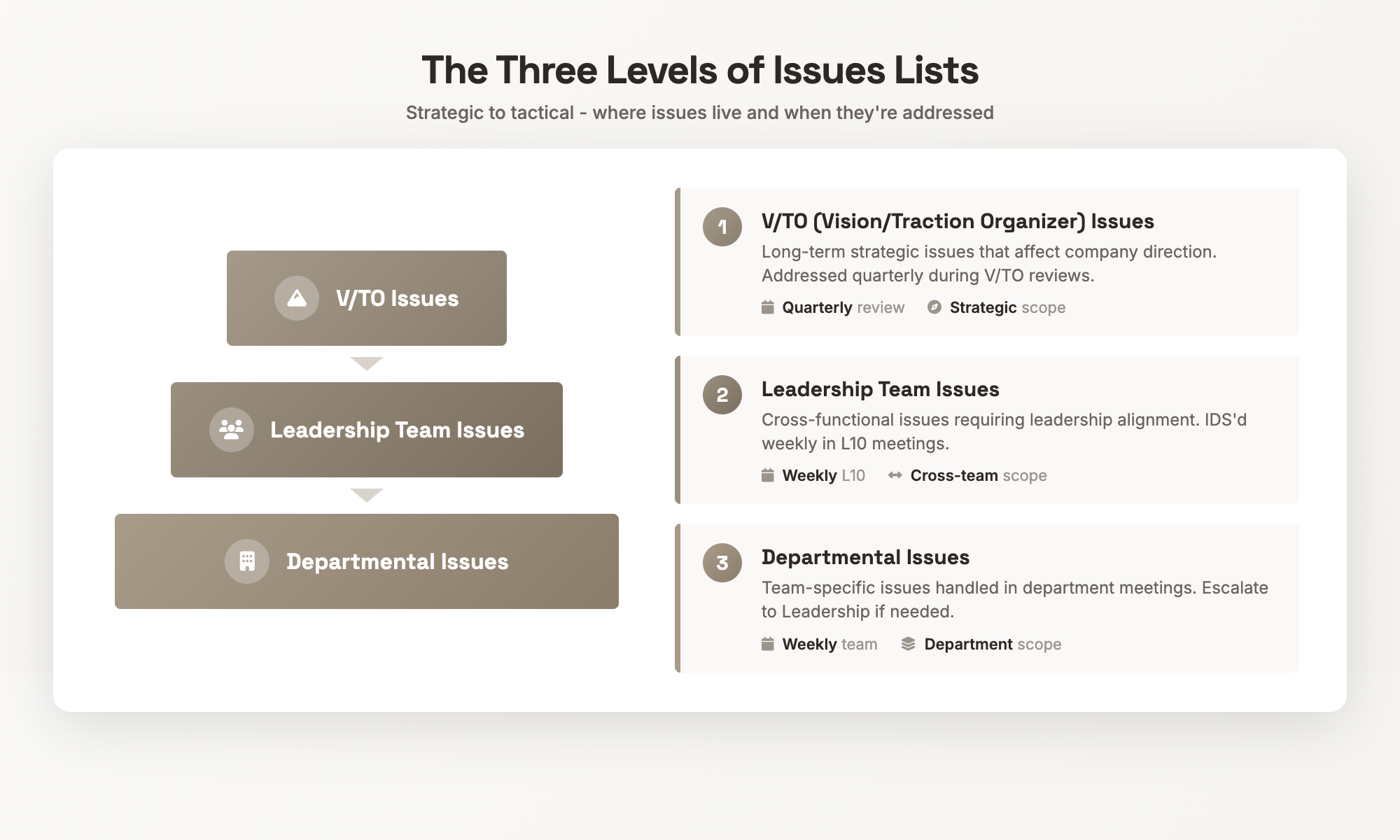
At EOS, we categorize issues lists into three levels:
- V/TO Level Issues (aka Long-Term Issues) are the larger, strategic issues that will take longer than a quarter to be resolved. You will only review this list at your quarterly planning but not during your weekly L10 meetings.
- Leadership Team Issues are issues that span multiple functions (departments) and will require input from more than just one department. This is the list that will be used at your L10 meetings.
- Departmental Issues are more specific to your team and will not require input from your leadership team.
| List Level | Review Period | Common Issues |
|---|---|---|
| V/TO (Strategic) | Quarterly | Market Expansion, Major Investments |
| Leadership Team | Weekly L10 Meeting | Cross-Departmental Issues, Company Decisions |
| Departmental | Department Meeting | Team Operations, Process Improvements |
Issue List Hygiene — Remove solved issues immediately. Archive long-term issues and handle them differently than recurring ones. Remove issues that remain unaddressed after a period of time.
📥 Download: IDS Issues Tracker (Google Sheets) - Template with columns for date, issue, owner, status, and resolution notes
What is a Level 10 meeting?
An L10 meeting (Level 10 Meeting) occurs on a weekly basis, typically at the same time on the same day every week, and lasts for 90 minutes. It is a Level 10 Meeting. Every Leadership Team Member meets for 90 minutes to review how they’re performing as a company, generate issues, and use IDS (Identify, Discuss, Solve) to resolve any actual or current issues.
Gino Wickman originated the Level 10 meeting concept in his book, Traction. By aspiring to make every meeting a “10 out of 10,” the purpose of the Level 10 meeting structure is to create an efficient way to eliminate the waste that lowers the overall score of a meeting.
So what does this look like? L10 meetings serve as a forcing function – to force issues to be exposed, discussions to occur and decisions to be made, as well as providing an opportunity for everyone to have some form of accountable task tracking via visible/reusable task lists. Research backs this statement, as there are five Meetings Design Elements, that produce productive meetings versus time wasting meetings.
Why Are Level 10 Meetings Called Level 10?
Participants provide a score of between 1 and 10 at the end of every L10 Meeting. A 10 indicates that everyone in attendance actively participated and that key participants addressed the key issues. Leaving the meeting with specific Action Steps ensures the group's continued effective interaction in subsequent meetings. If they receive a score below 10, the group determines what they could have done differently to earn a 10.
The scoring functions as a diagnostic instrument for identifying potential systemic problems. When teams consistently score 7 or 8, it can indicate issues such as having the wrong people in attendance or consistently addressing non-critical issues while ignoring critical issues.
There are teams that resist the practice of scoring themselves because they feel like they are being rude or confrontational. This discomfort is often an indicator of a larger systemic problem; the team is not comfortable providing honest feedback to one another. The objective isn't to score 10 on every meeting (because there are times due to factors outside the control of the team members that would preclude achieving a 10), but to maintain consistent improvement and demonstrate a trend of improvement over a series of months, moving up toward a rating of 10.
The 90-Minute Framework For Eliminating Waste In Meetings
A Level 10 meeting has a set time of 90-minutes, divided into 7 segments. Each segment has specific time constraints which create a discipline among the participants.
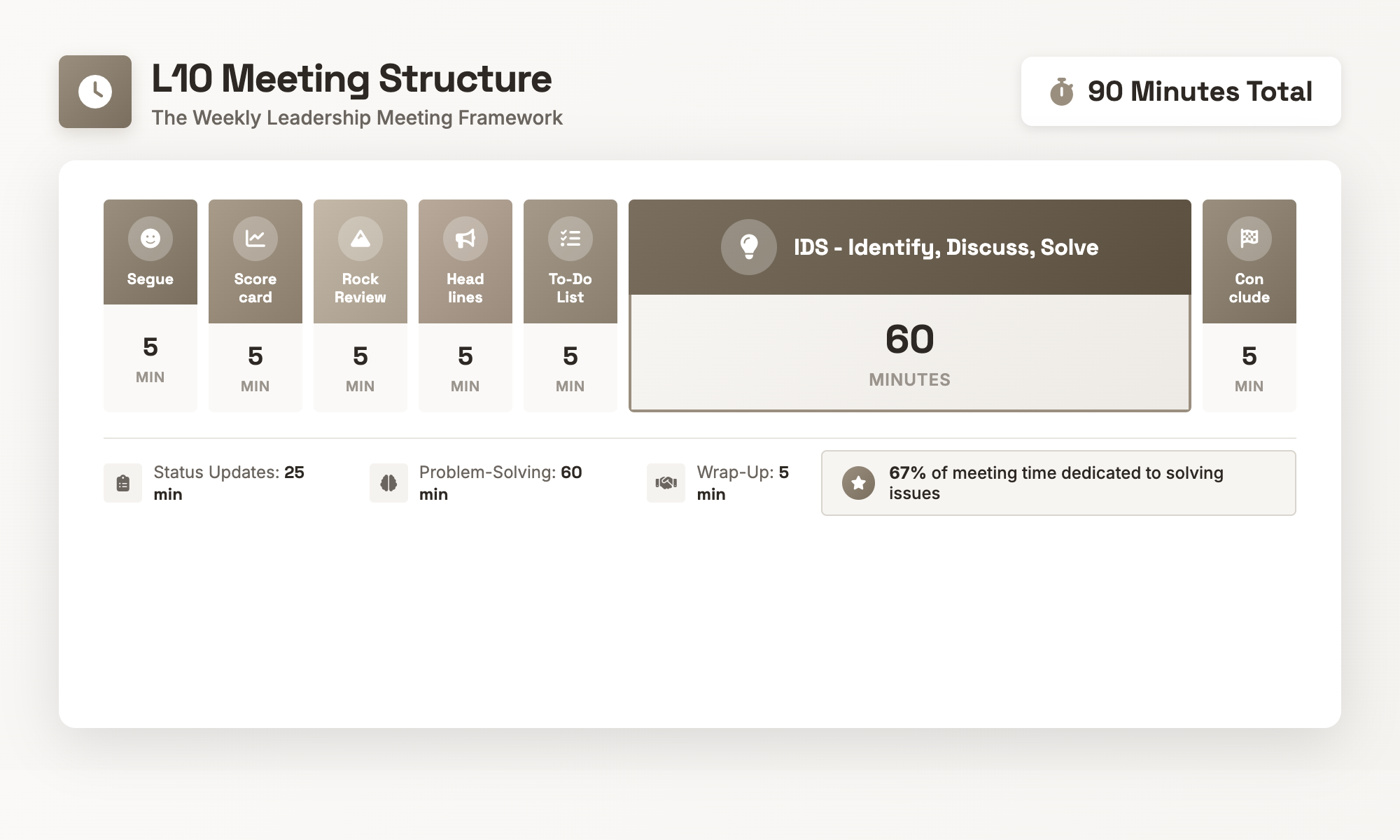
| Segment | Duration | Objective |
|---|---|---|
| Personal development | 5 Minutes | Share personal and professional good news / wins |
| Metric evaluation | 5 Minutes | Weekly metrics review—Are we on track? |
| Priority evaluation | 5 Minutes | Review of quarterly priorities |
| Company & employee headlines | 5 Minutes | Updates respective to Customers and Employees |
| Review of our to-do list | 5 Minutes | Evaluation of our respective to-do list (Have you completed this?) |
| Identification, discussion & solution identification of issues | 60 Minutes | Solving Problems—This is the Main Purpose of the Meeting |
| Recap/Meeting Evaluation | 5 Minutes | Evaluate the meeting by reporting any items still to be done AND rate our meeting. |
According to the EOS model of structuring a weekly accountability meeting, there are 25-minutes allocated to report on performance prior to allocating 60-minutes for problem solving within the same meeting. Research indicates structured problem-solving has a direct correlation with project success especially for teams with limited/ no historical knowledge of each other.
The Level 10 Meeting Agenda – A Template
This is the framework for holding together your meeting, and this section explains all seven segments.
Five-Minute Segue
Each participant will share a personal and professional success they've had during the last 7 days. By starting with wins, we reset our state of mind, strengthen connections with each other, and create positive momentum before the group continues on to other activities. We'll go around the circle quickly, providing 30 seconds per person (maximum).
Scorecard Evaluation (5 Minutes)
Go over your 5-15 most important daily metrics for your business. For each metric you need to rate them either "on track" or "off track." If you rate a metric as "off track," it means the metric will automatically go to the issues list for IDS and no explanation is needed.
The level 10 meeting scorecard promotes accountability and transparency. If a metric shows up as "off track" for three consecutive weeks then there is a pattern that needs to be addressed immediately.
📥 Download: L10 Meeting Scorecard Template (Excel) - KPI columns with conditional formatting for on/off track status
Rock Review (5 mins)
Each member of the leadership team will work towards achieving a set of 3-7 quarterly priorities called rocks. The rocks, like the scorecard, will either be on or off track.
Rocks are a bridge between the quarterly plan and the weekly plan for execution.
Employee and Customer Updates (5 Minutes)
Provide meaningful updates that cannot fit within the content sections of this meeting: new customers, employee concerns, competitive threats, market feedback. The updates are only provided as headings, and if an update requires deliberation, add the item to the issues list.
To-Do List Review (5 Minutes)
Over the next five minutes, the team will review and complete last week's to-do items to see whether they are complete. Items that were not completed will not be addressed (there's no point) other than to IDS them one-at-a-time if they recur frequently. There is no such thing as "partial credit" on a to-do item. Approximately 90% of your to-do items should be completed.
Having to-do item discipline is intended to create a mechanism for tracking your progress long-term; over the course of one week, there should be a lot of small completed to-do items, but over the course of three months, those small completed items will accumulate and become a considerable amount of progress. Regularly operating below the 80% completion rate is a sign that the to-do items are overly ambitious for your capabilities or that team accountability needs to be strengthened.
IDS: Focus of the Meeting (60 Minutes)
The L10 IDS phase is where the real focus of the meeting takes place, with 60 minutes spent identifying and discussing issues, as well as coming up with solutions for those identified in the L10 meeting.
3-2-1 Priority Protocol:
- Read through the full issues list
- Each person silently identifies their top three
- Vote quickly and take top-voted issues in order
Each issue should be addressed with IDs until they are resolved. After the 60 minutes have expired IDS will stop. Any unresolved issues will carry over to the next week.
The L10 agenda for an EOS meeting allocates a majority of the time to IDS because the leadership team delivers the most value in this area.
Conclude (5 Minutes)
- Recap to-dos with owner and due date
- Cascading messages — what needs communicating to broader teams
- Rate the meeting from 1-10
Ending on time is non-negotiable.
📥 Download: L10 Meeting Agenda Template (Excel/Google Sheets) - Complete agenda with all seven segments and timer guidance
Roles & Responsibilities in L10 Meetings
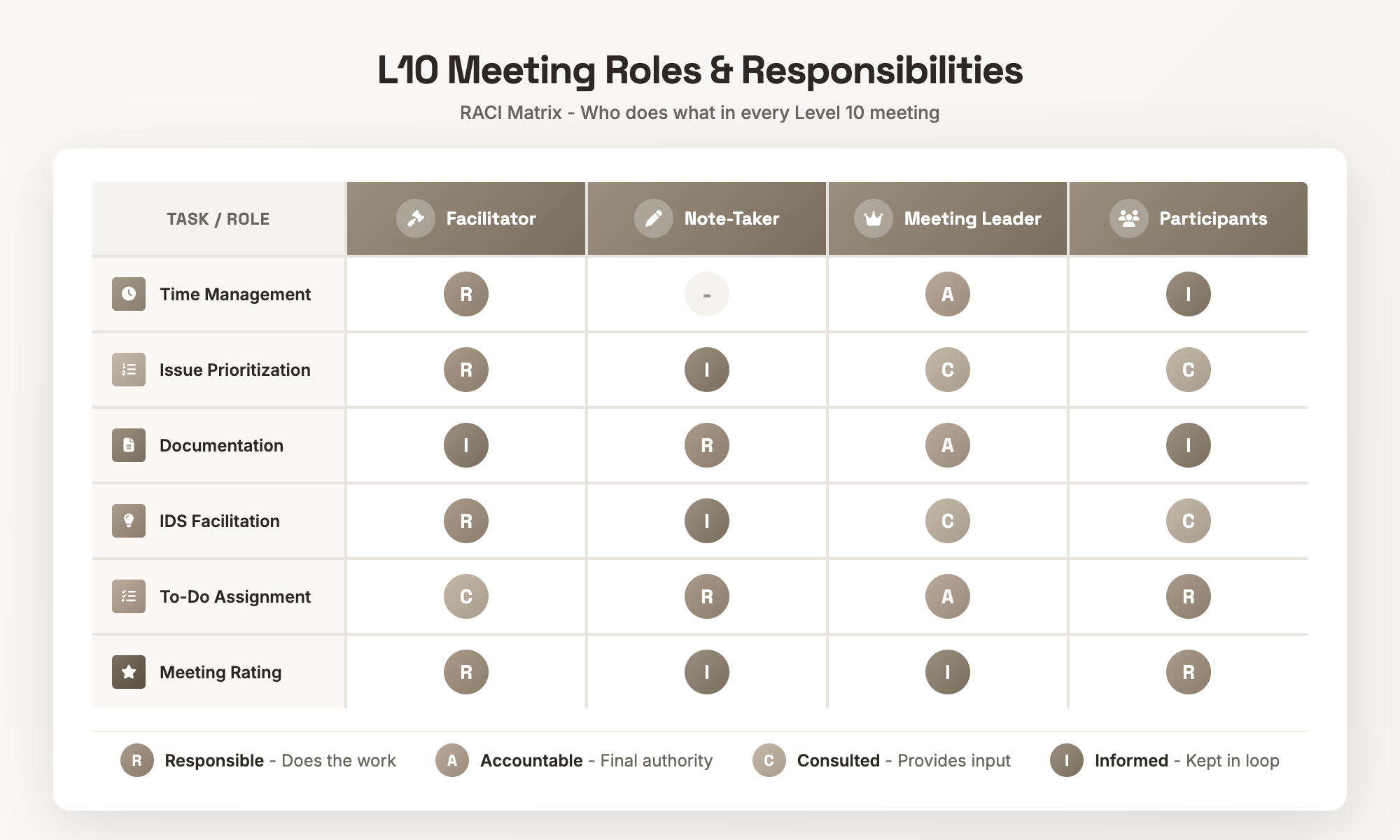
When roles are uncertain; it's very difficult to operate smoothly with a L10 meeting. Having clarity as to who has responsibility for each part of the meeting prevents problems from developing and the derailment of the otherwise well-meaning team.
| Role | Primary Responsibilities | Generally Fills Role |
|---|---|---|
| Facilitator | Controls time, enforces structure, keeps discussion on track | Integrator, COO |
| Note-Taker | Documents To-Do’s, documents decisions, records changes to issues list | Rotating or Admin |
| Meeting Leader | Sets the priority process for the agenda, ensures the right issues get addressed and participants provide input | Integrator |
| Participants | Participate in discussion; own metrics/rocks; complete To-Do’s | All members of the Leadership Team |
The accountability chart shows who is accountable for the various functions within the organization; e.g. if there is a person accountable for sales; they will discuss the sales metrics. Understanding the overall accountability of the organization, creates an understanding of who should participate in meetings.
The Facilitator's Playbook
Core Facilitator Responsibilities:
- Start exactly on time. Even if the CEO is walking down the hall.
- Keep segments within time limits. When scorecard review hits 5 minutes, it's over.
- Cut off tangents immediately. "Great point—adding it to the issues list."
- Ensure everyone speaks once before anyone speaks twice during IDS.
- Call for the solve. "What's the action? Who owns it? What's the deadline?"
Handling Difficult Participants:
- "You've made that point—let's hear from others."
- "This issue keeps recurring. Let's IDS why we're not solving it permanently."
When to Escalate vs. Solve In-Meeting
Solve In-Meeting When:
- The issue can be resolved in 15 minutes or less
- Delay would cause meaningful harm
- The issue requires cross-functional agreement
Escalate Out of Meeting When:
- Resolution requires research or data not available
- The issue involves only 2-3 people
- Complexity requires a dedicated working session
- The issue should become a Rock for next quarter
Decision-making efficiency improves when teams learn this distinction.
Common IDS and L10 Meeting Dysfunctions
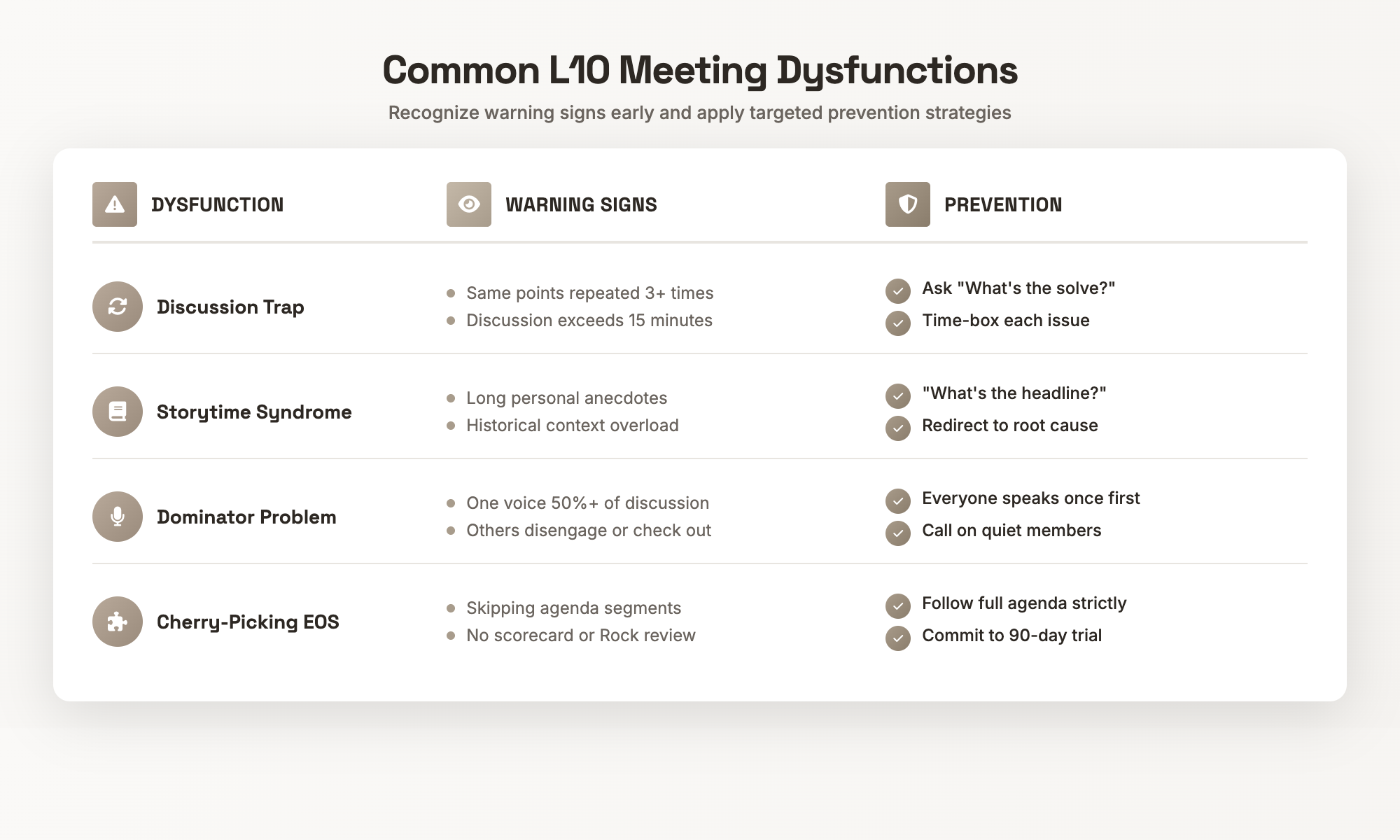
The following summarizes how many teams exhibiting a similar understanding of structure can still fall victim to dysfunctional behavior regarding their meetings.
| Dysfunction | Warning Signs | How to Prevent |
|---|---|---|
| Discussion Trap | Having the same discussion take place multiple times over 20 minutes | Time box the subject; what is the solution? |
| Repeater Problem | One person continuously repeating their same point | Facilitator needs to redirect attendees |
| Soft Resolve | "We'll have to monitor this situation" is seen as a resolution | Provide specific to-do items with owners |
The Circle of Talk
The group identifies a problem, and after 25 minutes of talking about it (talking in a circle), nothing has been decided or moved toward. Each person has provided input into the discussion (2 times), but no one has moved toward the final decision. Time is running out; frustration is growing; and finally, someone makes a comment about "tabling" the issue, which is a means of saying they are going to drop it until next week.
Signs of recognition:
- The same person speaks more than three times on a single issue
- New information stopped emerging 10 minutes ago
- Participants start checking phones or mentally disengaging
Releasing the trap: The facilitator needs to take some action and say, "You’ve talked about this for 15 minutes now; what is the specific action that we will be using, and more importantly who is going to be responsible for it?"
The reason there is often a trap is that the team has not confronted an uncomfortable truth; collaborative problem solving must result in the team dealing with the tension created by not addressing these issues, rather than going in circles around them.
The Repeaters Problem and the Use of Story Time
"Repeater" makes their point three times (first, the second time, and the third time). The "Storyteller" uses personal stories or other stories to derail discussions.
Intervention for repeater: "You've made that point, and we understand. Let's proceed with something else." For Storyteller: "Excuse me. Let me interrupt you and ask what your recommendation is."
Why Some Teams Fail at Self-Implementing IDS
- Cherry-picking tools. Teams adopt comfortable parts while skipping accountability measures.
- Treating L10 as optional. When the meeting conflicts with anything else, teams cancel.
- Lack of external accountability. No one calls out compromises to the framework.
- Insufficient commitment. Leaders intellectually accept EOS but never emotionally commit.
If your organization has trouble implementing self-implementation, you may want to look for an EOS Implementer (at least 1 time). An outside perspective can help you to see where you've lost your focus.
Running L10 Meetings for Remote and Hybrid Teams
The L10 framework was created to be used in conference rooms. Today, teams are working in remote and hybrid ways on a global basis, and are holding their meetings on screens. The principles still apply, however, they must be adapted to achieve results.
Technology Setup for Virtual L10 Success
Essential Infrastructure:
- Reliable video platform with stable connectivity
- Shared digital workspace displaying the agenda and issues list in real-time
- Quality audio via headsets—laptop mics create echo and frustration
Principle of Life Size: Create an on-screen representation of remote participants that gives them a feeling of presence within the meeting setting; some companies expect all participants to utilize video conferencing tools for all meetings regardless of their on-site status therefore creating an equal experience.
Creativity Challenge Solutions: Studies have shown that coordinating virtual meetings produces fewer creative ideas than in-person sessions; alternate options exist for creating these venues such as utilizing short scheduled chat breaks between long duration IDS sessions and/or employing virtual whiteboards for collaborative brainstorming.
Making Sure Everyone Has an Equal Chance to Participate From Wherever They Are
Hybrid meetings tend to be challenging because the folks in the meeting room create their own group dynamic while those who are participating remotely are just watching.
Dedicated Facilitator Focus:
- Explicitly call on remote participants by name during IDS
- Watch the video grid for raised hands
- Pause periodically: "Let me check with remote colleagues—any reactions?"
Practical Team Alignment Tactics:
- Pair remote and in-office participants on shared to-dos
- Rotate meeting times if participants span time zones
- Use asynchronous pre-work to reduce real-time discussion needs
- End with explicit commitments read aloud
It is not about replacing all of the face-to-face interactions by any means; rather, it's about making virtual L10 meetings work well enough to ensure that the quality of weekly executions will not suffer due to lack of physical contact.
Measuring L10 Meeting Effectiveness
If you don't measure activity, then it is difficult to gauge an improvement made. A rating at the conclusion of the meeting is a way to measure effectiveness but adding both quantitative metrics on attendance and behavioral observation makes the measurement of effectiveness more comprehensive.
What Drives Improvement? The Scoring Process
Start each meeting score at 10 points and deduct points for specific violations of the agenda or rules.
| Metric | Target | Deduction |
|---|---|---|
| Meeting began on time | Started exactly on time | -1.0 |
| Meeting ended on time | Ended exactly on time (90 minutes) | -0.5 |
| To-do completion rate | 90%+ of to-dos completed | -0.25 for every 10% below target |
| Participation in IDS | Every member spoke at least once | -0.25 |
| Issues resolved with owner + deadline | Every solved issue has clear owner and due date | -0.5 per missing element |
Record scores weekly, while reviewing results monthly. Receiving a 7.5 does not signify dysfunction. However, four consecutive scores less than eight would signal on-going trend disconnected from the typical benchmarking scores listed above.
Leading Indicators of L10 Mastery
Positive Indicators:
- Eager issue submission — Team members add issues between meetings because they trust those issues will get addressed
- Focused discussions — IDS conversations stay on topic naturally
- High to-do completion — Consistently hitting 90%+ completion
- Declining issue recurrence — Same issues stop appearing week after week
- Candid ratings — Participants give honest ratings, including 7s and 8s when warranted
Warning Signs:
- Issues list shrinks to only 2-3 items (people stopped surfacing problems)
- Same to-dos roll for multiple consecutive weeks
- Rating discussions become perfunctory ("10, 10, 10, okay we're done")
- Meeting frequently runs over 90 minutes
The Final Examination: L10 Meeting "Want" vs "Having To"
Are members of the team desiring their attendance at the L10 meeting or are they attending out of obligation? The teams who are executing this properly say that the L10 is their most effective meeting of the week.
From IDS to Action - Ensuring Follow-Through
The value of any decision is zero if there are no follow-up actions. The difference between stating that "we solved this in our meeting" and "our issue has been resolved" is where many groups fall short.
The Three Resolution Types
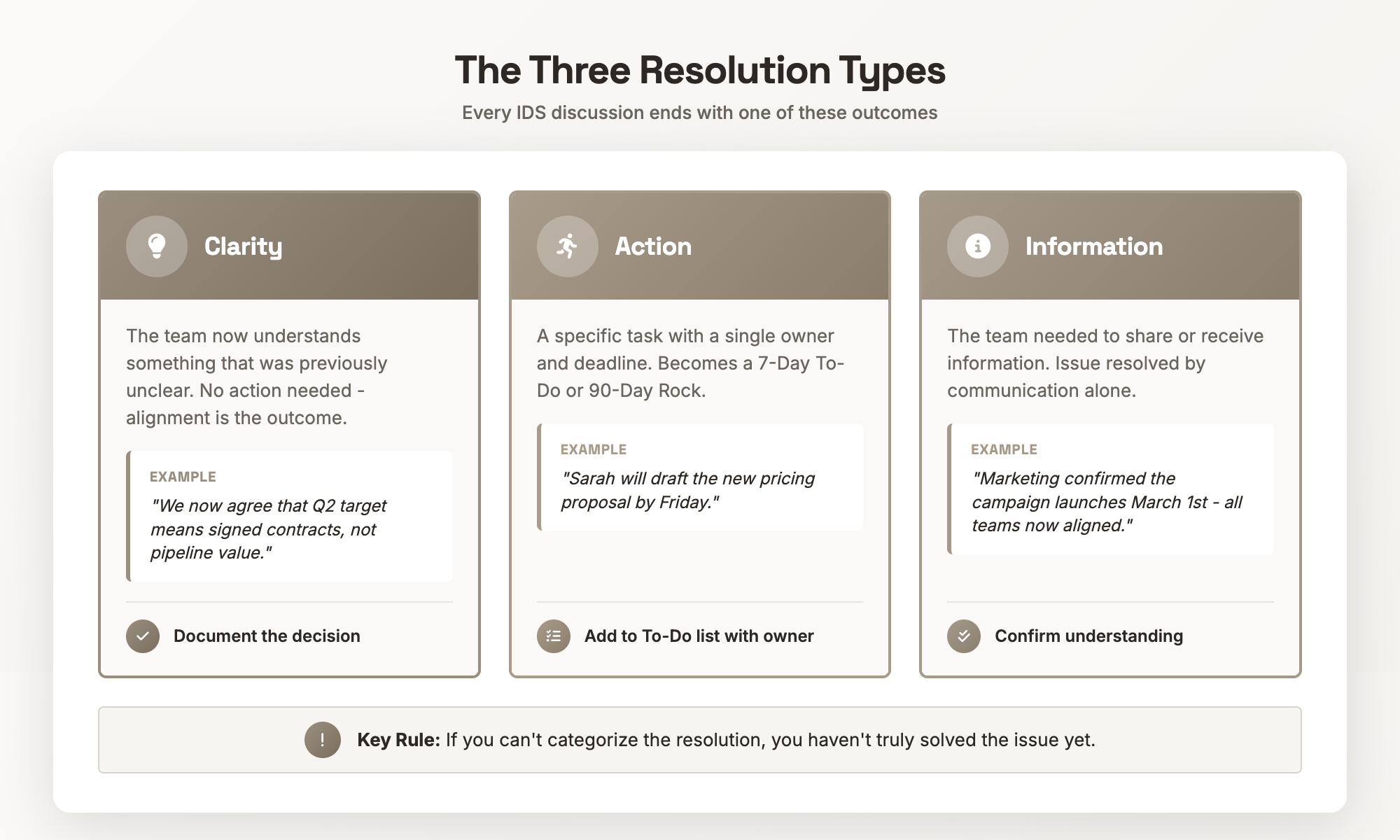
1. Clarity Resolution - The definition of "solution" is to reach a common understanding of the issue; therefore, no additional action is needed as the issue was purely informational.
2. Action Resolution - An individual agrees to take a certain action by a specific date/time. Action items must have the following characteristics: a specific product (deliverable), one owner for the action item, and due date (generally 7 calendar days).
3. Information Resolution - The team requires additional information before making a decision. The request for additional information is valid, but it can be abused. If you ask for additional information but cannot state specifically what information you need, then you are delaying a response.
Creating 7-Day and 90-Day Solutions
7-Day Solutions (To-Do Lists)
Weekly to-do lists can be completed within a strict week. Good examples of 7-day solutions include:
- Narrow in scope
- Clearly defined completion criteria
- Require no more than a few hours of focused work
3-Month Solutions (Rocks)
An issue needing ongoing focus over weeks or months becomes a Rock through the upcoming QTR. Rocks are the most important 3 to 7 things each member of the leadership team will accomplish in a 90-day period.
When you see the following signs with an issue, you can make it a Rock:
- It keeps appearing on the issues list without resolution
- It requires coordination across multiple departments over time
- It represents a strategic initiative rather than an operational fix
- Completing it would meaningfully advance annual goals
Problems that are so large they cannot be put on a to-do list but are not yet ready to be considered as rocks are considered to be in the danger zone. These issues can lay unresolved for months with continuous discussion surrounding them without resolution. They can be resolved by either breaking them into smaller pieces or committing to complete them as a "rock". Limbo is where issues die.
When a team doesn't complete a to-do from the last traction meeting, it is publicly known. When one team misses a rock deadline, every other team on the call knows it. Teams that are executing traction have proven themselves to be dependable.
How Hinto AI Accelerates Meeting Documentation
Decisions are made through the IDS process, whereas decisions and direction are typically assigned through L10s. Unfortunately, not all of that output actually makes its way out of the meeting; instead it typically disappears from memory and is lost in a notebook that was thrown away or in a document that never gets reread.
You need to have reliable, persistent documentation of your L10s in order for your L10s to be effective.
How We Turn Meeting Videos into Actionable Items
At Hinto AI, we convert recorded meeting videos into useful documentation. Our AI technology transcribes the audio and video content of your meeting and automatically creates an actionable and easy to read document.
How does this help for L10 meetings?
- Process Documentation — When IDS reveals a process needs improvement, recording the improved walkthrough generates immediate SOPs
- Decision Capture — Important decisions become searchable and referenceable
- Training Material Generation — Key workflows convert to step-by-step guides that accelerate onboarding
Building Your L10 Knowledge Base
Eventually, documentation strategy creates an Organizational knowledge base. Develop documentation from L10 meetings, such as:
- Solved issues and their resolutions for future reference
- Process changes resulting from IDS sessions
- Standard operating procedures for recurring tasks
- Decision rationale so future team members understand why
With Hinto AI you can publish your knowledge base and search for it instantly, or you can export it as a .md or .html file for use in your application.
The vision is to make the intelligence created by L10 meetings available and usable beyond the meetings themselves.
Frequently Asked Questions About IDS and L10 Meetings
In business, what does the acronym 'IDS' refer to?
The acronym IDS means Identify, Discuss, and Solve. It is a business process in the EOS model of business management. In the Identify Phase, you clarify the reason for an issue present. Next, you explore possible solutions through Discussion and finally select a specific course of action that includes individuals assigned specific responsibilities through the Solve Phase.
What Are L10 Meetings in EOS?
A L10 meeting is an EOS meeting that lasts 90 minutes and recurs once a week. As its name conveys, all meetings should strive to be rated a "10." "L10" is organized into seven distinct segments: segue, scorecard, rock review, headlines, to-do list, IDS (60 minutes), and conclusion.
The duration of a Level 10 meeting is exactly a period of ninety minutes, neither over nor under this time limit. This streamlined time frame enhances the meeting’s efficient use of time with status updates taking no longer than twenty-five minutes and there being sixty minutes remaining for IDS issues to be resolved during the meeting.
How is IDS different from "ordinary" methods of solving problems?
IDS has a defined process, which includes identifying the real problem, then collaborating on alternative solutions with input from all participants, then making a commitment to an agreed-upon course of action with a designated owner and a timeline. This helps avoid repetitive discussions, and ensures that everything will be resolved.
L10 meetings can technically be run without implementing the full EOS system; however, their effectiveness will not be as high. In order to run L10 meetings effectively, you must employ Rocks (your quarterly priorities), the Scorecard (weekly metrics), and your Accountability Chart (i.e., the roles assigned within your organization).
Although implementing the agenda structure will provide improvement over meetings that already exist even if they are not implemented fully.
When no action is taken on an identified issue, that issue will remain on the list to be resolved in the next week's meeting. If the same issue shows up on the list for several weeks in a row, it has created a pattern that the organization and IDS should be aware of. Is there a reason why this issue has not yet been resolved?
How to assign priorities to IDS issues?
Prioritization involves a team vote on the top three issues. Each person quietly marks their votes and then the team votes on only those three issues in descending order of vote totals.
What is the Function of Rocks in an L10 Meeting?
In a L10 Meeting, Rocks are 90-day priorities that are reviewed in a 5-minute segment. Each participant shares whether they are on-track or off-track to accomplish their Rocks. Off-track Rocks will automatically move to the Issues List to be discussed during the IDS session.
References
- Brucks, M. S., & Levav, J. (2022). Virtual communication curbs creative idea generation. Nature, 605, 108–112. https://www.nature.com/articles/s41586-022-04643-y
- Easton, G. S., & Rosenzweig, E. D. (2012). The role of experience in six sigma project success: An empirical analysis of improvement projects. Journal of Operations Management, 30(7–8), 481–493. https://onlinelibrary.wiley.com/doi/10.1016/j.jom.2012.08.002
- Johnson, K., Morais, C., & Patelli, E. (2025). Enhancing procedure quality: Advanced language tools for identifying ambiguity and high-potential violation triggers. Reliability Engineering & System Safety, 264(Part A), 111308. https://linkinghub.elsevier.com/retrieve/pii/S0951832025005095
- Kauffeld, S., & Lehmann-Willenbrock, N. (2012). Meetings matter: Effects of team meetings on team and organizational success. Small Group Research, 43(2), 130–158. https://journals.sagepub.com/doi/10.1177/1046496411429599
- Leach, D. J., Rogelberg, S. G., Warr, P. B., & Burnfield, J. L. (2009). Perceived meeting effectiveness: The role of design characteristics. Journal of Business and Psychology, 24(1), 65–76. https://link.springer.com/article/10.1007/s10869-009-9092-6
- Wickman, G. (2011). Traction: Get a Grip on Your Business. BenBella Books.

Product updates, feature announcements, and best practices from the Hinto product team.
Ready to Build a Better
Knowledge Base, Faster?
Get Started Free & Create Your First Article in Minutes